


Choosing a security camera sounds simple until you start comparing bullet cameras, dome cameras, PTZ cameras, IP cameras, PoE systems, cloud storage, lens options, night vision ranges, and hidden cameras.
Security cameras can be classified by shape, connection method, installation environment, visibility, and function. The best type depends on what you need to see, where the camera will be installed, how visible the camera should be, and how the footage will be recorded.
A camera used to scare off intruders is not always the same camera used to collect evidence discreetly.

What Are the Main Types of Security Cameras?
The main types of security cameras include bullet cameras, dome cameras, turret cameras, PTZ cameras, wired cameras, wireless cameras, IP cameras, PoE cameras, indoor cameras, outdoor cameras, 4G cameras, panoramic cameras, video doorbells, and hidden security cameras.
Each type is built around a different balance of coverage, installation method, visibility, and monitoring purpose.
For outdoor deterrence, choose bullet or turret cameras. For offices and retail stores, choose dome, turret, or PoE cameras. For large areas, choose PTZ or panoramic cameras. For simple home installation, choose wireless cameras. For remote sites without WiFi, choose 4G cameras. For discreet monitoring, choose hidden cameras where legally allowed.
By Shape
Camera shape affects installation position, viewing angle, visibility, and tamper resistance. The most common shape-based types are bullet cameras, dome cameras, turret cameras, and PTZ cameras.
Bullet cameras are more visible. Dome cameras look cleaner indoors. Turret cameras are easier to adjust. PTZ cameras cover large spaces with remote movement.
By Connection Method
Connection method affects stability, installation cost, and system design.
Wired cameras are more stable but require cabling. Wireless cameras are easier to install but depend on signal quality. IP cameras send digital video through a network. PoE cameras use one Ethernet cable for both power and data.
Wireless does not always mean battery-powered. Many WiFi cameras still need a power adapter.
By Environment and Visibility
Indoor cameras are designed for controlled environments. Outdoor cameras need weather-resistant housings, night vision, and stronger mounting. Hidden security cameras are designed for discreet monitoring instead of visible deterrence.
This is where many buyers make the wrong choice. A camera type is only useful when it matches the environment.
Security Camera Types Compared at a Glance
|
Camera Type |
Best For |
Main Advantage |
Main Limitation |
|
Bullet Camera |
Entrances, driveways, warehouses |
Visible deterrence and long-range view |
Easy to notice |
|
Dome Camera |
Offices, shops, lobbies |
Lower-profile appearance |
Harder to adjust after installation |
|
Turret Camera |
Fixed indoor and outdoor monitoring |
Easy angle adjustment |
Less discreet than dome cameras |
|
PTZ Camera |
Parking lots, factories, large sites |
Pan, tilt, and zoom coverage |
Higher cost and more setup work |
|
Wired Camera |
Long-term fixed systems |
Stable power and signal |
More installation work |
|
Wireless Camera |
Homes, small shops, temporary setups |
Easy installation |
Depends on WiFi stability |
|
IP Camera |
Modern network systems |
Digital video and remote access |
Requires network setup |
|
PoE Camera |
Professional multi-camera systems |
Power and data through one cable |
Needs PoE switch or NVR |
|
Indoor Camera |
Homes, offices, retail interiors |
Compact and easy to place |
Not built for harsh weather |
|
Outdoor Camera |
Exterior security |
Weather resistance and night vision |
Needs proper mounting |
|
4G / Cellular Camera |
Remote sites without WiFi |
Works without wired internet |
Needs mobile signal and data plan |
|
Panoramic / Fisheye Camera |
Large rooms or open areas |
Wide 180°–360° coverage |
Detail drops at distance |
|
Video Doorbell |
Front doors and entrances |
Visitor monitoring and communication |
Limited coverage area |
|
Hidden Camera |
Discreet indoor monitoring |
Low visibility and evidence collection |
Must be used legally |
For most homes and small businesses, wireless or PoE cameras are the easiest starting point. For commercial projects, dome, turret, bullet, and PTZ cameras are often combined. For discreet monitoring, hidden security cameras are the right category, but only in legally permitted locations.
Common Security Camera Types by Shape
Bullet Cameras
A bullet camera is a cylindrical security camera usually mounted on a wall, pole, or bracket. It is one of the most recognizable types of security cameras.
Choose a bullet camera when you want people to clearly see that an area is being monitored.
Bullet cameras work well at gates, driveways, warehouse doors, loading docks, parking lot edges, and exterior walls. Their shape makes the camera direction easy to understand, which helps deterrence. Many bullet cameras also support stronger infrared night vision or optical zoom than compact indoor cameras.
The weakness is obvious: they are not discreet. If the camera is within reach, it can also become a target. For outdoor use, mounting height and cable protection matter as much as the camera body.
Bullet cameras are best when visibility is part of the security strategy.
Dome Cameras
A dome camera is a security camera enclosed in a round dome-shaped housing, often mounted on ceilings or soffits. It is common in offices, retail stores, restaurants, hotels, elevators, and corridors.
Dome cameras are a good choice when you need visible monitoring without making the space feel aggressive or industrial.
The dome shape makes it harder to see the exact lens direction. Some models are also vandal-resistant, which makes them useful in public or semi-public areas. A dome camera above a retail checkout counter, for example, can monitor activity without looking as harsh as a large bullet camera.
A dome camera is not automatically an indoor camera. Some dome models are weather-rated for outdoor use. The real deciding factor is the housing quality, IP rating, and installation method.
Turret Cameras
A turret camera, also called an eyeball camera, is a fixed security camera with a ball-and-socket style design. It gives the installer more freedom to aim the lens after mounting.
Turret cameras are often a practical middle choice: easier to adjust than dome cameras and less visually aggressive than bullet cameras.
They are widely used in homes, small businesses, warehouses, and office entrances. Compared with dome cameras, turret cameras usually have fewer infrared reflection problems because there is no clear dome cover in front of the lens. That can make night images cleaner in some installations.
Turret cameras are not as discreet as dome cameras, but they are simple, flexible, and reliable for fixed-angle monitoring.
PTZ Cameras
A PTZ camera is a pan-tilt-zoom camera. It can move left and right, tilt up and down, and zoom in on specific areas. Some PTZ cameras support preset patrol routes, auto-tracking, and remote control through an NVR, software, or mobile app.
Choose a PTZ camera when one camera needs to cover a large area and someone will actively monitor or control the view.
PTZ cameras are useful in parking lots, factories, logistics yards, large warehouses, schools, and perimeter surveillance. A fixed camera records one direction. A PTZ camera can follow movement or zoom into a gate, vehicle lane, or loading area.
The tradeoff is cost and complexity. A PTZ camera is not always better for a shop entrance or small office. If the camera is not actively controlled or properly preset, a fixed camera may capture the important area more reliably.
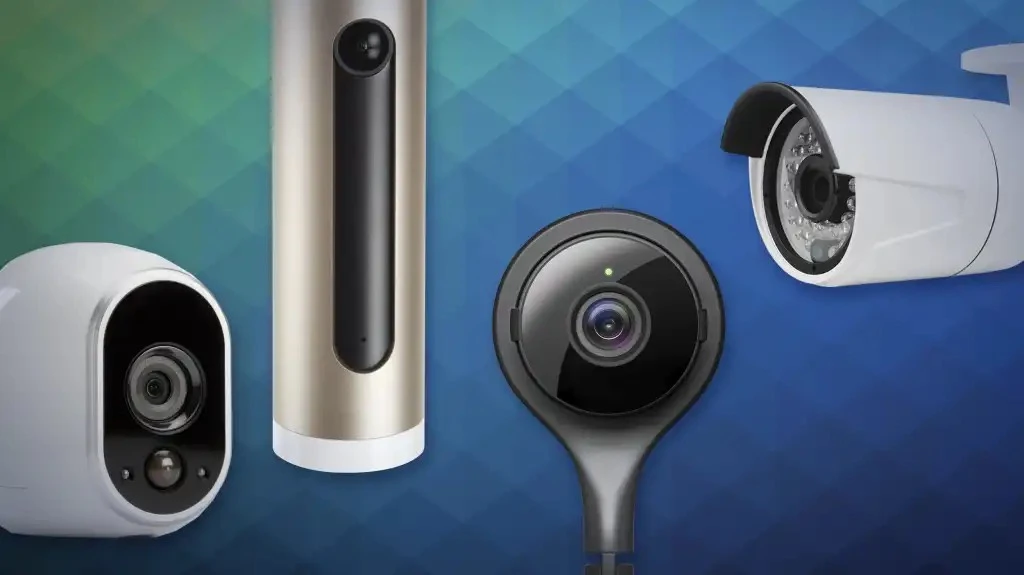
Wired, Wireless, IP, CCTV, and PoE Cameras Explained
Wired, wireless, IP, CCTV, and PoE describe how a camera connects, sends video, or receives power. They are technical classifications, not shape-based camera types.
Wired vs Wireless Security Cameras
Wired security cameras use cables for video, power, or both. They are better for stable, long-term systems. Commercial sites, warehouses, factories, and multi-camera projects often prefer wired or PoE systems because they reduce signal problems.
Wireless security cameras send video through WiFi. They are easier to install and useful for homes, small shops, rentals, and temporary monitoring. The downside is signal reliability. Thick walls, weak routers, crowded networks, and long distances can reduce performance.
Wireless cameras are not always cable-free. Many still need plug-in power.
IP vs CCTV Cameras
An IP security camera is a network camera. It sends digital video through a network and often supports remote viewing, high resolution, smart detection, and NVR recording.
CCTV originally meant closed-circuit television. In common use, it often refers to traditional surveillance systems, especially analog cameras connected to DVRs. Some older or upgraded systems use HD-over-coax technology, which allows higher-resolution video over existing coaxial cable.
If a building already has coax cabling, HD-over-coax may reduce upgrade cost. If the site has CAT5e or CAT6 network cabling, IP or PoE cameras are usually easier to scale.
PoE Security Cameras
PoE means Power over Ethernet. A PoE security camera receives power and sends data through one Ethernet cable.
For buyers, the benefit is simple: cleaner wiring and more stable installation. A shop with eight cameras, a warehouse with multiple aisles, or an office with fixed monitoring points will usually be easier to manage with PoE cameras connected to a PoE NVR or PoE switch.
PoE systems still require planning. Long cable runs, high-power PTZ cameras, and outdoor routes may need additional design work.
4G / Cellular Security Cameras
A 4G or cellular security camera uses a SIM card and mobile data instead of WiFi or wired internet. It is useful for construction sites, farms, remote yards, temporary storage areas, and locations where network cabling is not realistic.
The limitation is operating cost and signal strength. If the cellular signal is weak, the camera will not perform well. If the site records continuously, data usage can become expensive.
Indoor, Outdoor, and Hidden Security Cameras
Indoor Security Cameras
An indoor security camera is built for controlled environments such as homes, offices, shops, reception areas, stock rooms, and shared indoor spaces.
Indoor cameras usually focus on compact size, clean appearance, wide viewing angle, two-way audio, and easy installation. A small WiFi camera in a retail office or reception area may be enough if the goal is basic activity monitoring.
Placement still matters. Avoid pointing indoor cameras directly at strong backlight from windows. If a person's face becomes dark because the camera is facing bright sunlight, the camera type is no longer the main problem.
Outdoor Security Cameras
An outdoor security camera is designed to handle rain, dust, temperature changes, glare, insects, and low-light conditions.
Outdoor cameras should have proper weather resistance, commonly IP66 or IP67 when exposed to rain and dust. They also need suitable night vision, strong brackets, cable protection, and mounting positions that reduce tampering.
Outdoor cameras must handle rain, dust, temperature changes, glare, and low-light conditions. Do not use a standard indoor camera outdoors unless it is rated for that environment.
Do not place an infrared night vision camera behind glass. The IR light can reflect back into the lens and ruin the night image. Roof eaves, nearby walls, and opposing cameras can also cause infrared reflection.
Mounting a camera too high may reduce tampering, but it can also make faces too small to identify. For many storefronts and entrances, the best position is high enough to stay out of easy reach, but low enough to capture useful facial detail.
Hidden Security Cameras
A hidden security camera is designed to record without drawing attention to itself. It may be built into an object, housing, module, fixture, or small enclosure. The purpose is discreet monitoring, not visible deterrence.
Hidden security cameras are most useful when the goal is to observe real behavior, collect evidence, or integrate monitoring into an environment without making the camera obvious.
Typical applications include retail loss prevention, stock room monitoring, office internal security, temporary investigation, smart home device integration, and OEM discreet monitoring products.
A hidden camera is not a replacement for every visible camera. If you want to scare away intruders, a visible bullet camera or active deterrence camera usually works better. If you want low-profile evidence collection, a hidden camera is more suitable.
|
Need |
Better Choice |
|
Deter intruders |
Visible camera |
|
Record natural behavior |
Hidden camera |
|
Monitor outdoor perimeter |
Bullet or PTZ camera |
|
Blend into indoor space |
Hidden or dome camera |
|
Build a discreet OEM device |
Hidden camera module |
Hidden cameras must be used responsibly. They should not be installed in bathrooms, changing rooms, bedrooms, or any place where people reasonably expect privacy. Audio recording laws also vary by country and region, so buyers should check local regulations before use.
How to Choose the Best Security Camera for Your Needs
The best security camera is not the one with the longest feature list. It is the one that matches your monitoring purpose, installation environment, power supply, storage method, and visibility requirement.
Define What You Need to See
Before choosing any camera type, decide what you need to see and from what distance.
Detecting motion, recognizing a face, and reading a license plate are different requirements. A camera used in a 20 ft office does not need the same lens or night vision range as a camera mounted on a 20 ft warehouse ceiling.
A wider view is not always better. The wider the scene, the less detail each person or object receives.
Choose Visible or Discreet Monitoring
Visible cameras are better for deterrence. Bullet cameras, outdoor cameras, floodlight cameras, and active deterrence cameras tell people the site is being watched.
Hidden cameras are better when the goal is discreet monitoring or evidence collection. They should be used only in legally allowed environments.
This decision should come before product selection. A visible camera and a hidden camera solve different problems.
Decide Wired, Wireless, PoE, or 4G
For long-term business systems, wired or PoE cameras are usually safer choices. They reduce dependence on WiFi and are easier to manage at scale.
For homes, small shops, or temporary installations, wireless cameras may be enough. For remote sites without WiFi, 4G cameras can work, provided mobile signal is stable.
Check Resolution, Lens, Night Vision, AI Detection, Storage, and Power
Resolution matters, but it does not solve every problem. Higher resolution helps digital zoom, but digital zoom only enlarges the image already captured. It cannot create missing detail.
Lens choice matters. A fixed wide-angle lens is good for general coverage. A varifocal or optical zoom lens is better when you need details farther away.
Night vision range is not the same as identification range. A camera may detect someone at 100 ft but only identify a face at a shorter distance, especially at night.
AI detection can reduce false alerts by distinguishing people, vehicles, pets, or general motion. For retail stores, offices, and warehouses, this may matter more than another small increase in resolution.
Storage also affects cost and risk. Cloud storage is convenient and can protect footage if the camera is stolen, but it may require monthly fees. SD cards, DVRs, and NVRs can reduce long-term cost, but the recorder or memory card must be protected.
Best Security Camera Type by Scenario
Different security needs require different camera types. A home entrance, retail store, warehouse, office, parking lot, and discreet monitoring project should not automatically use the same camera.
|
Scenario |
Recommended Camera Type |
|
Home entrance |
Video doorbell, wireless outdoor camera, or bullet camera |
|
Living room or shared indoor area |
Indoor camera where legally appropriate |
|
Retail store |
Dome, turret, PoE, or hidden camera |
|
Office |
Dome, turret, or hidden security camera |
|
Warehouse |
Bullet, PTZ, or PoE camera |
|
Parking lot |
PTZ or long-range bullet camera |
|
Large open room |
Panoramic or fisheye camera |
|
Yard or driveway deterrence |
Floodlight or active deterrence camera |
|
Remote construction site |
4G / cellular camera |
|
Discreet monitoring |
Hidden security camera |
|
Long-term commercial system |
PoE or wired camera system |
A home user usually cares about easy installation, remote viewing, and budget. A business buyer cares more about stable recording, multi-camera coverage, maintenance, and usable evidence. A B2B product developer also needs to think about housing design, lens placement, WiFi module stability, battery life, heat dissipation, and storage configuration.
That is where camera type becomes a product decision, not just a purchase decision.
Work with an OEM Hidden Camera Manufacturer
Choosing the right security camera type answers the main question: what do you need to monitor, and under what conditions?
Bullet cameras are best for visible outdoor deterrence. Dome and turret cameras fit offices, shops, and fixed indoor monitoring. PTZ and panoramic cameras work for large areas. Wireless cameras help with quick installation. PoE cameras suit stable business systems. Hidden cameras are the right choice for discreet monitoring where legally allowed.
For brands, distributors, and security product companies, camera selection is also a product development decision. Housing design, lens position, WiFi module, battery capacity, storage method, heat control, and installation style all affect the final product.
Allcam is a China-based hidden camera manufacturer supporting OEM and ODM discreet surveillance camera solutions. If you are developing a hidden camera product or looking for a custom OEM hidden camera manufacturer , Allcam can help you design and manufacture camera solutions based on your market, installation scenario, and product positioning.

FAQ
What are the main types of security cameras?
The main types of security cameras include bullet cameras, dome cameras, turret cameras, PTZ cameras, wired cameras, wireless cameras, IP cameras, PoE cameras, indoor cameras, outdoor cameras, 4G cameras, panoramic cameras, video doorbells, and hidden security cameras.
Which type of security camera is best for home?
For most homes, a wireless outdoor camera, video doorbell, or indoor WiFi camera is the easiest starting point. For entrances and driveways, choose an outdoor-rated camera. For shared indoor spaces, choose a compact indoor camera. Hidden cameras should only be used where legally allowed.
Are wired security cameras better than wireless cameras?
Wired security cameras are better for stable, long-term systems. Wireless cameras are better for quick installation and flexible placement. For homes and small shops, wireless may be enough. For commercial systems with multiple cameras, wired or PoE cameras are usually more reliable.
What type of camera is best for outdoor security?
Bullet cameras, turret cameras, PTZ cameras, and outdoor PoE cameras are common choices for outdoor security. The key factors are weather rating, night vision, mounting height, cable protection, and tamper resistance. Do not use an indoor camera outdoors unless it has the right environmental rating.
What type of security camera works without WiFi?
A 4G or cellular security camera can work without WiFi by using a SIM card and mobile data. It is useful for construction sites, farms, temporary storage areas, and remote yards. It still needs stable mobile signal and a suitable data plan.
When should you use a hidden security camera?
Use a hidden security camera when the goal is discreet monitoring, evidence collection, or low-profile integration into an indoor environment. Hidden cameras are not designed for visible deterrence. They must be used according to local privacy and recording laws.
Which security camera type is best for businesses?
Retail stores often use dome, turret, PoE, and hidden cameras. Warehouses usually need bullet, PTZ, or PoE systems. Offices may use dome or discreet cameras depending on privacy rules. Most business systems work best when several camera types are combined.