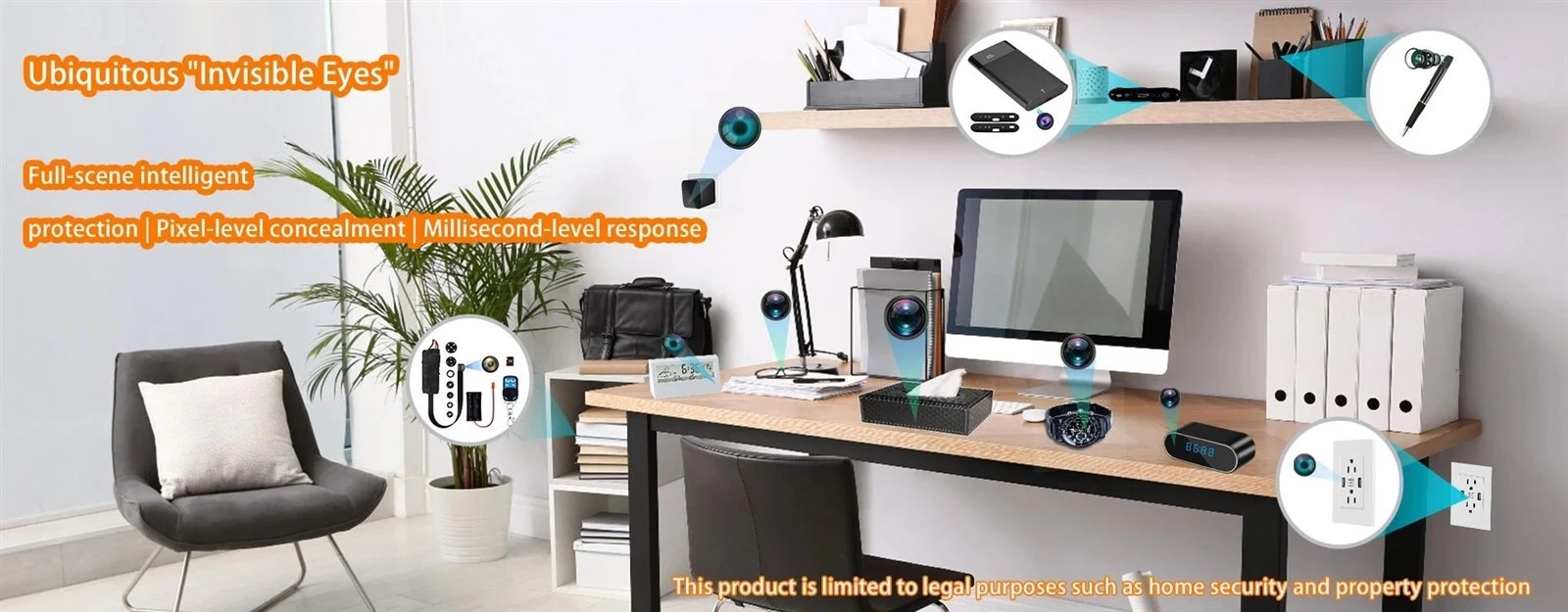

Dual-band WiFi improves hidden camera performance by giving the camera access to both 2.4GHz and 5GHz networks. That added flexibility matters because the two bands behave differently. 2.4GHz usually provides better range and wall penetration, while 5GHz offers more available bandwidth and often faces less congestion.
For a compact hidden camera, the benefit is not simply higher speed. It is the ability to operate more reliably across different distances, buildings, router setups, and network loads. If you are new to network-connected surveillance devices, understanding how WiFi hidden cameras work provides useful background for the wireless concepts discussed below.

What Does Dual-Band WiFi Mean in a Hidden Camera?
A dual-band WiFi hidden camera is a camera that can connect to compatible 2.4GHz and 5GHz WiFi networks, rather than being limited to only one frequency band.
That distinction matters because many older WiFi cameras and smart-home devices support only 2.4GHz. Modern routers, mesh systems, and ISP gateways often support both bands, sometimes under the same network name or SSID. A dual-band camera is therefore easier to integrate into a wider range of home and office networks.
Dual-band support does not automatically mean that the camera combines both bands for twice the speed. In most camera applications, the device connects through one band at a time.
It also does not necessarily mean that every camera can switch automatically between 2.4GHz and 5GHz. Automatic band selection depends on the WiFi chipset, firmware, router configuration, and network implementation.
The practical benefit is simple: the camera has two wireless options instead of one.
2.4GHz vs 5GHz: What Is the Difference for a Hidden Camera?
Both WiFi bands can carry camera video, but they solve different wireless problems.
|
Factor |
2.4GHz WiFi |
5GHz WiFi |
|
Typical coverage |
Longer |
Shorter |
|
Wall penetration |
Better |
Weaker |
|
Available bandwidth |
Lower |
Higher |
|
Network congestion |
Often higher |
Often lower |
|
Best fit |
Longer distance, more walls |
Shorter distance, busy networks |
|
Typical camera use |
Stable coverage |
Higher-throughput streaming |
These differences are why 5GHz should not be treated as an automatic upgrade over 2.4GHz. Each band has a practical role.
Where 2.4GHz Performs Better
The main advantage of 2.4GHz is coverage.
Because it operates at a lower frequency, it generally travels farther and penetrates walls and other building materials more effectively than 5GHz. That makes it useful when a hidden camera is several rooms away from the router, installed on another floor, or placed near the edge of WiFi coverage.
For many 1080P and 2K camera applications, a stable 2.4GHz connection can provide enough bandwidth for live viewing and normal remote monitoring. The exact result still depends on bitrate, network congestion, signal quality, walls, antenna design, and camera placement.
For a deeper look at those variables, see our guide to the factors that affect WiFi camera range.
Where 5GHz Performs Better
5GHz is more useful when network capacity and congestion are the main concerns.
It offers more available bandwidth and typically gives devices access to a less crowded wireless environment than 2.4GHz. That can help with live viewing, playback, downloading recordings, and other data-heavy camera functions when the camera is relatively close to the router.
The trade-off is range. A strong 2.4GHz connection can easily outperform a weak 5GHz signal passing through several walls.
Neither band is universally better. The better choice depends on where the camera is installed and what the surrounding network looks like.

How Does Dual-Band WiFi Actually Improve Hidden Camera Performance?
The main performance advantage of dual-band WiFi is adaptability. It gives the camera or network more ways to respond to distance, interference, and bandwidth demand.
More Flexible and Stable WiFi Connections
A hidden camera installed near the router may work well on 5GHz, especially if the 2.4GHz band is busy. Move the same camera farther away or place several walls between it and the access point, and 2.4GHz may provide the more reliable connection.
This is why maximum theoretical speed should not be the first priority.
A strong 2.4GHz connection can be more useful than a weak 5GHz connection.
For camera use, stable connectivity often matters more than peak WiFi speed. Weak links can increase retransmissions, interruptions, and connection recovery attempts.
Less Exposure to 2.4GHz Network Congestion
The 2.4GHz band is widely used by smart-home devices and nearby WiFi networks. In a modern household or apartment building, cameras may share that spectrum with phones, smart bulbs, speakers, locks, TVs, and neighboring routers.
This becomes more noticeable when the network is busy. Video streaming, online gaming, video calls, and other connected devices can all increase wireless contention.
A dual-band camera gives users the option of moving the camera connection to 5GHz when signal strength is adequate. That does not eliminate congestion everywhere, but it reduces dependence on a single crowded band.
More Bandwidth Headroom for Live Video
WiFi cameras continuously move video data across the local network. Higher-resolution or higher-bitrate streams require more network capacity.
5GHz can provide more headroom for:
Live video viewing
Video playback
Downloading recorded clips
Higher-bitrate streams
Multiple connected devices operating at the same time
This does not mean 5GHz always removes buffering. Router performance, signal quality, interference, and video bitrate still matter.
Products built around higher-resolution wireless video illustrate why network capacity matters. A 4K WiFi hidden camera, for example, has to move an encoded video stream through the same local network used by other connected devices.
For remote access, local WiFi is only one part of the connection path. The router, Internet upload bandwidth, App, and P2P architecture also affect performance. Our hidden camera remote viewing setup guide explains those parts in more detail.
Better Compatibility With Modern Home WiFi
Many newer routers and mesh WiFi systems use one SSID for both bands. A user may see only:
HomeWiFi
rather than separate names such as:
HomeWiFi-2.4G
HomeWiFi-5G
This can cause setup problems with 2.4GHz-only cameras because users may need to change router settings or separate the two bands before pairing the device.
A dual-band WiFi camera reduces that dependency and fits more naturally into modern home network configurations.
Which WiFi Band Should You Use in Different Camera Installations?
The best band depends on the installation environment rather than the camera specification alone.
Large Homes or Cameras Far From the Router
A camera installed in a basement, garage, another floor, or a distant room often benefits from 2.4GHz.
The priority in these locations is usually:
Longer coverage
Better wall penetration
A stronger signal at distance
If the 5GHz signal becomes weak after passing through several walls, choosing it simply because it offers higher theoretical throughput can make the connection worse.
Apartments With Many Nearby WiFi Networks
City apartments create a different problem.
The router may be only a few meters from the camera, but many nearby wireless networks can compete for the same 2.4GHz spectrum. In that situation, 5GHz can provide a cleaner option when signal strength is good.
For a hidden camera in a dense apartment building, congestion may matter more than distance.
Plug-in designs are particularly common in this type of fixed indoor deployment. A compact 4K WiFi wall charger camera, for example, combines a fixed installation position with continuous network connectivity, making local WiFi conditions especially relevant.
Offices and Small Businesses With Many Devices
Business environments often contain laptops, smartphones, printers, access points, smart devices, and multiple cameras.
Here, dual-band support adds network planning flexibility. Cameras do not all need to compete on the same frequency band, and network administrators have more options for distributing devices.
For installations with several WiFi cameras, total network capacity matters as much as the specification of each individual camera.

Does 5GHz WiFi Improve Hidden Camera Video Quality?
Not directly.
A 5GHz connection does not turn a 1080P hidden camera into a 2K or 4K camera. Image quality is primarily determined by the camera hardware and video-processing pipeline, including:
- Image sensor
- Lens
- Native resolution
- Video bitrate
- Compression
- Image processing
- Lighting conditions
WiFi transports the video after the camera has created and encoded it.
That means there is an important difference between image quality and network performance.
5GHz can improve network conditions for a higher-bitrate stream, but it does not change the native image captured by the sensor.
Resolution also should not be treated as the same thing as bandwidth demand. Two cameras with the same resolution can use very different amounts of network capacity depending on their codec, frame rate, and bitrate settings.
A 1080P H.265 stream may commonly operate in the range of a few megabits per second, while higher-resolution or less-compressed video can require more. The actual requirement depends on the encoder settings and scene complexity. If compression efficiency is part of your product evaluation, our comparison of H.264 vs H.265 for security cameras explains how codec choice changes storage and bandwidth demand.
For WiFi planning, bitrate is often more useful than resolution alone.
Why Is WiFi More Challenging in a Mini or Hidden Camera?
Hidden cameras have physical design limitations that conventional cameras may not face.
The enclosure is often very small. Antenna space is limited. PCB dimensions are tightly constrained, and the antenna may need to fit inside a clock, charger, outlet, smoke-detector housing, or another compact form factor.
Some models also rely on batteries, which adds power and thermal constraints.
These limitations make RF design more sensitive to the relationship between:
Antenna size and placement
PCB layout
Housing materials
WiFi module design
Power consumption
Firmware
Installation position
Mini and hidden cameras may also be harder to reposition once installed. A visible camera can sometimes be moved to improve its signal path. A concealed or integrated design has less freedom.
This is why good dual-band performance is a system-level engineering issue.
Installing a dual-band WiFi module is not enough by itself. The antenna, PCB, firmware, enclosure, and RF layout all affect actual performance. This becomes even more important in a DIY hidden camera WiFi module, where module dimensions, antenna placement, power supply, and the final enclosure can all influence wireless results.
What Else Determines Hidden Camera WiFi Stability?
Dual-band support improves flexibility, but it cannot compensate for every weak point in the network.
WiFi camera stability also depends on:
- Distance from the router
- Number and type of walls
- Router quality
- Channel congestion
- Camera placement
- Antenna design
- Housing materials
- Video bitrate
- Number of connected devices
- Firmware behavior
- App and P2P architecture
- Internet upload capacity for remote viewing
A camera can have a strong WiFi signal and still perform poorly if the wireless channel is overloaded.
The opposite can also happen. A fast broadband connection does not guarantee stable camera streaming if the camera's antenna or local WiFi link is weak.
This is another reason to treat dual-band WiFi as part of the complete camera connectivity design rather than as a standalone performance feature.
What Should B2B Buyers Check in a Dual-Band Hidden Camera?
For distributors, security brands, private-label buyers, and OEM projects, a "5GHz supported" label is not enough.
A useful technical evaluation should cover both the WiFi specification and how it is implemented in the product.
Key questions include:
Does the camera support both 2.4GHz and 5GHz?
Which WiFi standards are supported?
Which 5GHz channels are available in the target market?
How is band selection handled?
Is automatic switching supported, or does connection behavior depend on the router?
Which WiFi module or chipset is used?
How is the antenna integrated into the housing?
Has WiFi stability been tested under weak-signal and congested conditions?
What video bitrate does the product normally use?
How are firmware, App, and P2P connectivity managed?
What RF certification is required for the destination market?
Advanced products may also involve WiFi 6, DFS support, or band-steering compatibility, depending on the target application and router environment.
For an OEM or ODM project, the wireless design should be considered together with the PCB, antenna, firmware, App, housing, and intended certification path. A capable hidden camera manufacturer should therefore be able to discuss more than resolution and WiFi frequency alone.
Buyers evaluating different product forms can also review Allcam's broader WiFi spy camera range to compare how wireless connectivity is integrated into different housings and use cases.

Dual-Band WiFi Gives Hidden Cameras More Room to Work
Dual-band WiFi improves hidden camera performance mainly by increasing wireless flexibility. 2.4GHz provides useful range and wall penetration. 5GHz adds more bandwidth and can reduce exposure to congested 2.4GHz environments. Together, they allow a camera to fit more installation conditions than a single-band design.
The final result still depends on antenna design, PCB layout, firmware, video bitrate, router quality, and the surrounding network.
Allcam develops and manufactures mini and hidden camera products for B2B buyers, including OEM and ODM projects involving wireless hardware, firmware, App, and product structure. If you are evaluating or developing a dual-band WiFi hidden camera, contact us to discuss the required network performance, product form factor, target market, and customization scope.
FAQ
Is 5GHz better than 2.4GHz for a hidden camera?
Not always. 5GHz is usually more useful when the camera is close to the router and the 2.4GHz band is congested. 2.4GHz is usually better when the camera is farther away or several walls are in the signal path.
Does 5GHz make a hidden camera image clearer?
No. It can improve network performance in suitable conditions, but image quality is determined mainly by the sensor, lens, resolution, processing, lighting, and video settings.
Can a 1080P or 2K camera work on 2.4GHz WiFi?
Yes. A stable 2.4GHz connection can provide sufficient bandwidth for many 1080P and 2K camera applications. Actual performance depends on bitrate, signal quality, congestion, and router performance.
Does a dual-band camera automatically switch between 2.4GHz and 5GHz?
Not necessarily. Dual-band means the camera supports both frequency bands. Automatic band selection or switching depends on the camera firmware, WiFi hardware, router, and network configuration.
Why does my router show only one WiFi network name?
Many modern routers and mesh systems use the same SSID for both 2.4GHz and 5GHz. The router manages compatible devices across the available bands without showing separate network names.