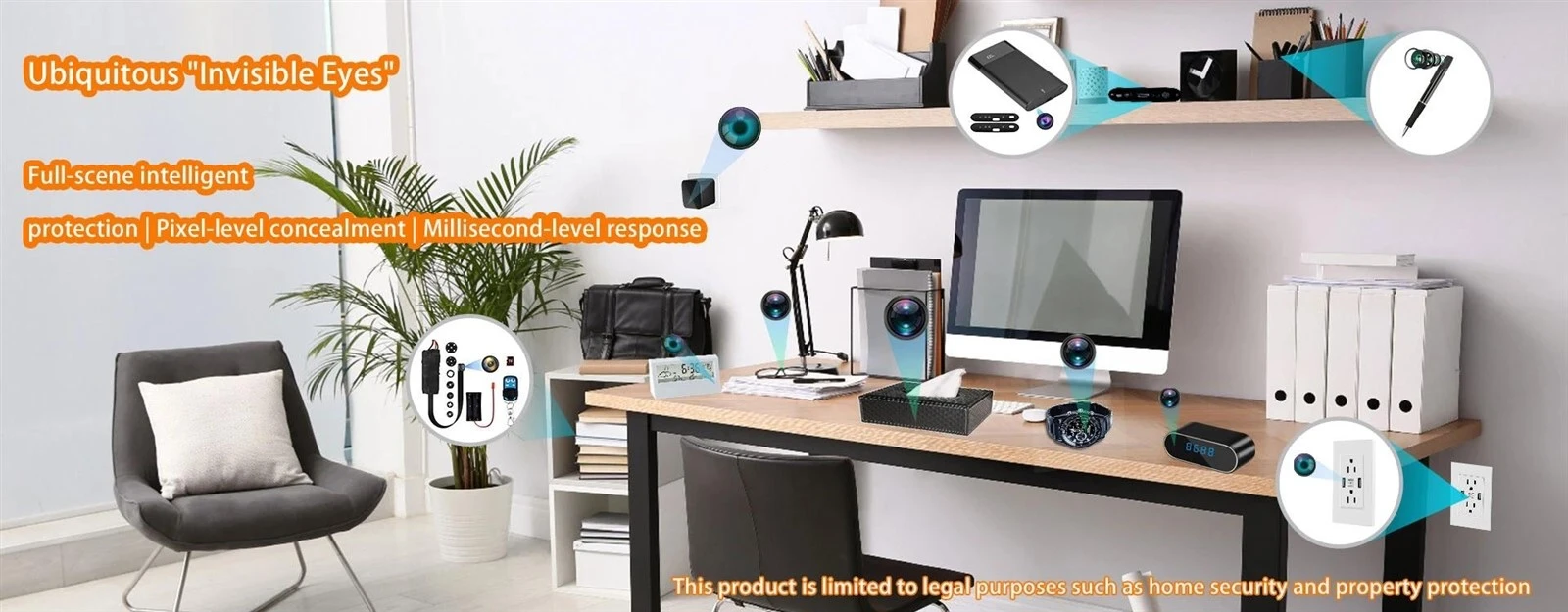

Customizing a hidden or mini camera usually involves several upfront costs before mass production begins. NRE, tooling, prototype samples, certification, firmware, app development, and production fixtures may all appear on the quotation. A light private-label hidden camera project may require only a few thousand dollars of additional work, while a deeper ODM project involving a new PCB, custom housing, firmware, and software can move well into the tens of thousands.
The biggest cost driver is usually simple: how much of the existing product platform can be reused.

What Does It Really Cost to Customize a Hidden Camera?
A custom hidden camera has two broad cost groups: one-time development costs and recurring production costs.
The production unit price covers the parts, assembly, testing, packaging, and manufacturing margin for every unit produced. Development costs are different. They pay for the engineering and validation required to get the product ready for production in the first place.
A typical cost map looks like this:
|
Cost Category |
What It Covers |
Typical Cost Nature |
|
NRE |
Mechanical, PCB, firmware, software, integration |
Usually one-time |
|
Tooling |
Injection molds, fixtures, jigs |
Mostly upfront |
|
Prototype Samples |
Engineering and verification units |
Paid by development stage |
|
Certification |
Target-market testing and compliance |
Project-dependent |
|
App / Firmware |
Custom functions, UI, connectivity |
One-time and sometimes ongoing |
|
Cloud / Server |
P2P, private cloud, server infrastructure |
May include recurring cost |
|
Production Unit Cost |
BOM, assembly, QC, packaging |
Recurring |
For planning purposes, a custom hidden camera project may see mechanical NRE around $2,000–$8,000, PCB/electronic NRE around $3,000–$12,000+, firmware or app NRE around $4,000–$15,000+, and injection tooling around $8,000–$30,000+.
Prototype batches may run around $500–$2,500, while compliance work can add roughly $3,000–$15,000, depending on the market and product configuration.
These numbers are useful for budgeting, but they should never be treated as a universal price list. A product built around an existing enclosure and proven electronics can be dramatically cheaper than a ground-up design.
NRE Costs: What Are You Actually Paying Engineers For?
NRE, or Non-Recurring Engineering, is the one-time engineering work required to turn a product requirement into something that can actually be manufactured.
For a hidden camera, that work may involve the enclosure, PCB, optics, firmware, wireless connection, app, and system integration.
Mechanical and Industrial Design
Mechanical NRE commonly covers:
- industrial design and 3D CAD
- internal structure
- lens position and aperture
- PCB and battery placement
- heat management
- buttons, ports, and mounting features
A reasonable planning range is around $2,000–$8,000.
Hidden cameras make mechanical design unusually important because the enclosure often dictates where every component can go.
A smoke detector hidden camera is a good example. A standard rectangular camera PCB may simply not fit inside a circular enclosure. Changing the outer appearance can therefore trigger an internal redesign.
PCB and Electronic Engineering
Electronic NRE typically includes:
schematic design
component selection
PCB layout
sensor and lens interfaces
Wi-Fi or 4G modules
storage
power management
battery integration
A typical range is around $3,000–$12,000+.
Form factor has a direct effect here. A mirror-frame camera may need a long, narrow board. A miniature module may require a highly compact multilayer PCB. Once the board shape changes, routing, antenna placement, heat, signal integrity, and component selection may also need to change.
For projects where the customer does not need a completely new electronics platform, starting from an existing DIY hidden camera WiFi module can reduce PCB development work and shorten the path to a functional prototype.
Firmware, App and System Integration
Firmware and software development can include motion-detection logic, recording behavior, sleep modes, power management, Wi-Fi/P2P connection, white-label app work, alarms, localization, and server integration.
Planning costs often fall around $4,000–$15,000+, depending on depth.
For connected cameras, software can easily become its own cost center. Depending on the project, development may extend from device firmware into mobile apps, P2P connectivity, private servers, cloud services, RTSP/NVR support, and multi-language interfaces.
For that reason, NRE is best evaluated by engineering scope, not by a fixed percentage of the total project value.

Tooling and Mold Costs: When Do You Need a New Mold?
Tooling is the physical production equipment used to manufacture the product. For plastic hidden camera housings, this usually means an injection mold, although assembly jigs, programming fixtures, and test fixtures may also be involved.
If you can reuse an existing wall clock, charger, outlet, smoke-detector shell, or other mature enclosure, a completely new mold may not be necessary.
That can remove one of the largest upfront expenses from the project.
Existing Housing vs. Custom Housing
Using an existing enclosure may allow you to focus customization on:
logo
packaging
firmware
sensor or lens
storage
battery
accessories
For example, an established product platform such as a USB wall charger hidden camera already has a mature enclosure architecture. If the project only requires branding, packaging, selected hardware changes, or firmware adjustments, the customer may be able to avoid developing a completely new plastic shell.
Once you change the housing geometry itself, the cost structure changes.
A new lens opening, battery compartment, internal bracket, port, button, or PCB mounting point may require a new mold or mold modification.
Aluminum or Soft Tooling vs. Steel Tooling
Typical planning ranges look like this:
|
Tooling Type |
Approximate Planning Range |
Typical Use |
|
Low-volume / soft tooling |
$5,000–$12,000 |
Pilot runs and smaller programs |
|
General custom injection mold |
$8,000–$30,000+ |
Standard custom housings |
|
Production steel mold |
$15,000–$35,000+ |
Higher-volume, longer-life production |
The final mold cost depends on the material, cavity count, part geometry, undercuts, sliders, lifters, wall thickness, finish, and tolerance requirements.
Mold material should match the expected production volume. Aluminum or softer tooling is often attractive for smaller programs because the upfront cost is lower and changes are easier. Hardened steel becomes more attractive as expected lifetime volume increases.
Budget for mold tuning as well. First shots often reveal small issues such as wall thickness, pin position, surface finish, or fit. The tooling quote should therefore be read as part of a development process, not as the end of one.
Prototype and Sample Costs: Why Are Custom Samples So Expensive?
Prototype samples are expensive because they are produced in small quantities, often with manual assembly, CNC-machined or 3D-printed parts, and much more individual testing than mass-production units.
A functional prototype may cost around $150–$500 per unit, while a development batch may run around $500–$2,500.
The value is in what the sample proves.
Engineering Prototypes / EVT
EVT, or Engineering Verification Test, is used to confirm that the product concept actually works.
Typical checks include:
sensor output
firmware boot
image quality
Wi-Fi connection
battery behavior
basic mechanical fit
At this stage, housings may still be 3D printed or CNC machined, and boards may be hand assembled.
DVT, Golden Sample and PVT
DVT, or Design Verification Test, is used when the design is more mature. Reliability, EMC/EMI, mechanical fit, thermal performance, and compliance preparation often happen here.
Once the design is frozen, several approved units may be kept as golden samples. These serve as the reference for dimensions, appearance, image performance, and functionality during mass production.
PVT, or Production Verification Test, validates the actual manufacturing process: final BOM, work instructions, assembly flow, yield, and line stability.
The exact quantity at each stage varies by project. The important part is that EVT, DVT, and PVT answer different engineering questions.
For a more detailed pre-production review, a structured hidden camera sample testing checklist can help verify image quality, wireless stability, recording behavior, power performance, and other critical functions before the order moves into mass production.
Samples should therefore be treated as risk-control spending. Problems caught before tooling or mass production are usually much cheaper to fix.
Certification, Software and Other Costs Buyers Often Miss
Compliance cost depends on the target country, wireless configuration, battery system, and final product design.
Depending on the market, a project may need to consider requirements related to:
FCC
CE
RoHS
REACH
TELEC
PSE
lithium battery transport testing
A practical planning allowance is roughly $3,000–$15,000 for certification and compliance work, although a simple product may come in below that and a multi-radio or multi-market product may go higher.
The number of wireless radios matters. Wi-Fi, Bluetooth, and cellular connectivity can each expand the testing scope. Compact hidden cameras can also be challenging from an EMC perspective because shielding space is limited.
Before fixing a compliance budget, check the hidden camera certification requirements for your intended market and product configuration. Existing approvals may sometimes reduce testing work, but design changes involving RF hardware, antennas, power systems, or other regulated elements can change the compliance scope.
There are also costs that may sit outside a basic hardware quotation:
- app white-labeling
- private server or cloud deployment
- packaging artwork
- manuals and translation
- production programming fixtures
- assembly jigs
- image-test fixtures
- mold modification
- compliance retesting after a design change
Tooling, in other words, is broader than the plastic mold alone.

How MOQ and Order Volume Change the True Cost Per Unit
MOQ, or Minimum Order Quantity, is the smallest production quantity a manufacturer will normally accept for a given project.
It matters because NRE, tooling, samples, and certification are fixed costs. The more units you produce, the less those costs add to each unit.
At Allcam, the current standard MOQ is around 200 pieces, while deeper ODM projects commonly fall in the 500–1,000 piece range, depending on product and customization depth.
A useful way to look at the project is through effective unit cost:
Effective Unit Cost = Production Unit Price + One-Time Project Costs ÷ Expected Production Volume
For example, assume:
NRE: $25,000
Tooling: $10,000
Samples: $2,000
Certification: $5,000
Total one-time investment: $42,000
|
Expected Volume |
One-Time Cost Allocated per Unit |
|
500 |
$84.00 |
|
2,000 |
$21.00 |
|
5,000 |
$8.40 |
|
10,000 |
$4.20 |
|
50,000 |
$0.84 |
That explains why two buyers can receive the same production unit price and still face very different project economics.
At lower volumes, one-time costs dominate. At higher volumes, BOM and manufacturing cost become the larger part of the equation.
MOQ and NRE can also trade against each other commercially. A supplier may accept lower NRE when expected volume is high enough to recover engineering investment through production margin. If order volume is still uncertain, understanding how to negotiate MOQ with a hidden camera factory can help you discuss trial quantities, future volume, tooling investment, and pricing tiers more productively.
How to Reduce Hidden Camera Customization Costs Without Cutting the Wrong Corners
The most effective cost savings usually come from reusing proven elements of the existing platform.
|
Cost-Saving Choice |
Main Cost It Can Reduce |
|
Reuse an existing housing |
Tooling + mechanical NRE |
|
Reuse a proven PCB |
Electronic NRE |
|
Use standard components |
Engineering and sourcing cost |
|
Start from existing firmware |
Firmware NRE |
|
Reuse an existing app/platform |
Software development |
|
Freeze requirements early |
Rework and mold changes |
|
Validate before opening the final mold |
Late-stage engineering changes |
|
Match mold material to actual volume |
Unnecessary tooling investment |
A housing change deserves special attention because it can create a chain reaction.
Consider a new smoke-detector enclosure. The exterior may look like a mechanical change, but it can force a different PCB shape, move the lens, change the antenna position, alter thermal behavior, and require another prototype cycle.
One cosmetic requirement can become a system-level engineering change.
That is why the best cost-control strategy is often to decide early which parts of the product genuinely need to be unique and which parts can stay on a proven platform.

How to Compare Hidden Camera Supplier Quotes Before You Commit
A quotation should show enough detail for you to understand where the money is going.
Check What the NRE Includes
Ask whether the engineering fee covers:
mechanical design
PCB design
firmware
app work
system integration
prototype support
A single "engineering fee" line is hard to compare unless the scope is clearly defined.
Confirm Tooling and Sample Scope
Check:
mold material
mold ownership
expected mold modifications
prototype quantities
golden sample
whether sample units are included in NRE
A cheaper tooling quote may simply refer to a different mold material or lower expected tool life.
Verify Certification, MOQ and IP Terms
Also confirm:
which certifications are included
whether test-unit preparation is included
whether retesting is included
MOQ
volume price tiers
mold ownership
PCB/design ownership
firmware or source-code rights
exclusivity and reuse rights
These questions should be part of a broader supplier evaluation. Price matters, but engineering capability, quality control, software support, manufacturing stability, and communication are equally important when you choose a hidden camera manufacturer for a long-term OEM or ODM project.
For an accurate custom camera quotation, prepare the core requirements before contacting the manufacturer: product type, dimensions, resolution, sensor or lens requirements, battery life, storage, Wi-Fi or 4G, app functions, expected quantity, packaging, and target market.
Conclusion
Hidden camera customization costs are easiest to understand when they are separated into engineering, tooling, validation, compliance, and production. Light customization can stay relatively inexpensive because much of the existing platform remains intact. A deeper ODM project involving new structure, PCB, firmware, app work, and tooling will require a much larger upfront investment.
The practical goal is to reuse proven technology where it makes sense, spend development money where differentiation actually matters, and compare suppliers on total program cost rather than one line item.
Allcam develops and manufactures Mini Camera and Hidden Camera products with customization covering structure, PCB, firmware, app, server, tooling, and mass production. If you have a product concept or an existing model you want to modify, contact our custom hidden camera manufacturing team with your target specifications and expected volume, and we can help break the project into a realistic cost and development plan.
FAQ
What is the difference between NRE and tooling?
NRE pays for engineering work such as mechanical design, PCB development, firmware, and integration. Tooling pays for physical manufacturing tools such as injection molds and production fixtures.
Do I need a new mold just to add my logo?
Usually no. Logo printing, packaging, manuals, and basic private-label work can normally use an existing enclosure. A new mold is more likely when the shape, internal structure, ports, or lens position change.
Is the sample fee included in NRE?
Sometimes. Some manufacturers bundle a defined number of engineering samples into NRE, while others charge sample units separately. The quotation should state which approach is being used.
Can NRE be reduced for a larger order?
Yes, in some projects. Higher expected production volume may allow the manufacturer to recover part of the engineering investment through future unit margin. The commercial structure varies by project.
Who owns the mold and product design?
Payment alone does not determine ownership. Mold ownership, PCB design rights, firmware rights, source-code access, exclusivity, and supplier reuse rights should all be written into the contract.
How long does a custom hidden camera project take?
Allcam's current project data gives a useful reference:
existing-product OEM: 3–5 days
moderate ODM: 7–15 days
deep customization or new mold: within 25 days
production lead time: 15–30 days
complete new-product development: about three months on average
Actual timing still depends on complexity, testing, tooling changes, and certification.
What information is needed for an accurate quotation?
The most useful starting information is product form, dimensions, resolution, lens and sensor requirements, battery life, storage, wireless connectivity, app requirements, expected order volume, packaging, and target market.