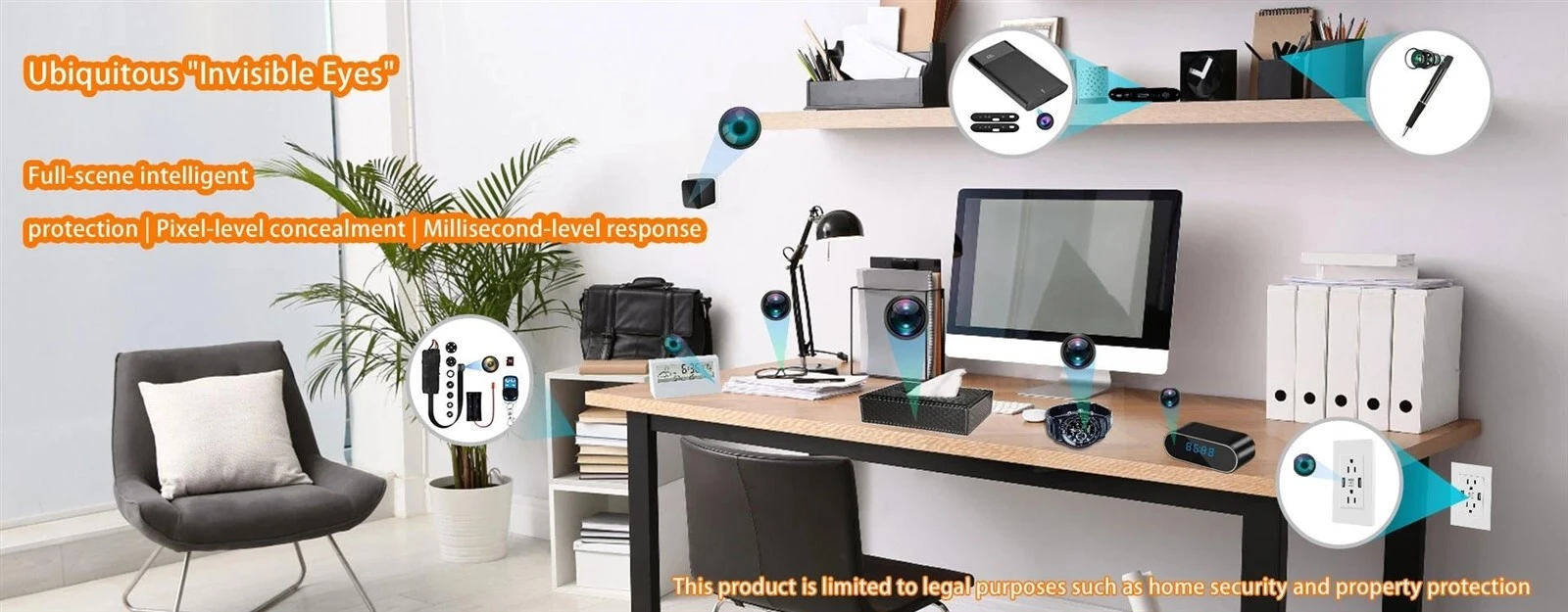

A home gym or garage studio can hold expensive fitness equipment, tools, electronics, bikes, and other gear while sitting in one of the less frequently watched parts of a property. A hidden camera-a compact surveillance camera designed to blend into its surroundings or occupy very little visual space-can provide discreet monitoring without turning the room into a visibly camera-heavy environment.
The useful part starts with placement. A poorly positioned 4K camera can tell you less than a well-positioned 1080p camera facing the right entrance.

Why Home Gyms and Garage Studios Need a Different Monitoring Plan
Home gyms and garage studios have a different physical layout from most living spaces.
A garage may have a large vehicle door, a side entrance, shelving, metal cabinets, workout racks, windows, and a door connecting directly to the house. A basement gym may be separated from the rooms people use most often. Detached garages introduce another problem: weaker Wi-Fi and fewer convenient power outlets.
There is also often a lot worth protecting. Free weights, treadmills, bikes, power tools, photography equipment, musical equipment, electronics, and workshop gear can quickly add up in value.
That makes these spaces a natural use case for garage monitoring cameras, home gym security cameras, and other discreet security devices.
The first step, though, should be deciding what needs to be monitored.
Start With Risk Zones Before Choosing a Camera
A common surveillance planning principle applies especially well here: map the important areas first, then choose the hardware.
For most home gyms and garage studios, the priority zones look something like this:
|
Monitoring goal |
Priority camera location |
What you want to capture |
|
Detect unauthorized entry |
Main garage door or primary entrance |
People entering and leaving |
|
Identify who entered |
Inside-facing entrance angle |
Face and upper-body detail |
|
Protect gym equipment |
Power rack, cardio or equipment zone |
Activity around valuable equipment |
|
Protect tools or stored gear |
Cabinet, shelving or workbench area |
Removal or handling of items |
|
Monitor access to the house |
Garage-to-house connecting door |
Movement between garage and living area |
|
Monitor general activity |
High corner or overhead position |
Wider room activity and movement |
The entrance is usually the strongest starting point.
Pointing a camera at an empty section of floor gives you very little useful information. Pointing it toward the route a person must take after opening the garage door gives you far more.
The same applies inside a home gym. If the expensive equipment is concentrated around a rack, treadmill, storage wall, or equipment cabinet, that area deserves better coverage than an unused corner.
Where Should You Place a Hidden Camera in a Garage?
Main Garage Entrance
The main entrance should normally have priority because almost everyone entering the space passes through it.
Position the camera so that a person moving into the garage travels through the useful part of the image, ideally with enough frontal or diagonal facial detail to identify what happened.
Be careful with daylight. A camera pointed directly toward an open garage door can face severe backlighting. The outside may be bright while the person inside becomes a dark silhouette.
Testing the camera with the garage door open is just as important as testing it at night.
Side or Pedestrian Door
Side entrances are easy to overlook, especially when the main garage door receives most of the attention.
If the side door is also an access route, it may deserve its own angle. This becomes more important when shelving, vehicles, workout racks, or storage cabinets block the main camera's view.
Equipment and Storage Areas
For a home gym, focus on areas such as:
free-weight and rack areas;
expensive cardio equipment;
equipment storage;
cabinets containing electronics or accessories.
For a garage studio or workshop, the equivalent areas may be tool cabinets, workbenches, bikes, photography equipment, musical gear, or storage racks.
A camera covering these areas helps document what happens after someone is already inside.
Door Between the Garage and the House
In an attached garage, this transition point deserves special attention.
Monitoring the route from the garage into the house can provide useful context around an entry event and makes it easier to distinguish someone who entered only the garage from someone who continued into the home.
General Room Coverage
A wider room view is useful, but one ultra-wide camera is not automatically enough.
Shelving, cars, gym racks, partition walls, and cabinets can all create blind spots. Larger or irregularly shaped garages may need two or more viewing angles.

How High Should a Garage Camera Be Mounted?
There is no universal mounting height.
A very high position provides good general coverage and makes the camera harder to obstruct, but steep overhead angles are less useful for facial detail. A lower position can capture faces more clearly but may be easier to block.
The practical approach is to test the image at the actual entry route.
You should be able to answer three questions:
Can I recognize a person's face?
Can I see their hands and the object or equipment they are interacting with?
Does furniture, a car, shelving, or gym equipment block the important part of the image?
If the answers are poor, change the angle before changing the camera.
What Features Matter Most in a Hidden Camera for a Home Gym or Garage?
Resolution matters, but it is only one part of usable image quality.
A useful purchasing checklist looks like this:
|
Feature |
What to look for |
Why it matters |
|
Resolution |
1080p baseline; 2K/4K where more detail is useful |
Helps preserve identifiable detail |
|
Low-light performance |
IR night vision or strong low-light sensor |
Garages are frequently dim or unevenly lit |
|
Field of view |
Wide enough for the target zone without excessive distortion |
Determines how much useful area one camera captures |
|
WDR / backlight handling |
Useful near garage doors and windows |
Helps with bright-background scenes |
|
Motion detection |
Adjustable sensitivity or detection zones |
Reduces unnecessary recording and alerts |
|
Storage |
microSD, cloud, NVR or a combination |
Determines retention and resilience |
|
Connectivity |
Wi-Fi where remote viewing is needed |
Enables app access and alerts |
|
Power |
Battery, plug-in, PoE or other continuous supply |
Determines maintenance requirements |
|
Form factor |
Disguised unit or mini camera module |
Affects installation and how naturally the camera fits the space |
Do You Really Need 4K?
Sometimes.
If the camera is covering a relatively large area and you may need to zoom into recorded footage, extra resolution can help. But resolution cannot compensate for bad lighting, extreme distance, motion blur, or a poor angle.
A tightly framed 1080p camera facing the entrance can provide more useful identifying detail than a 4K camera trying to cover an entire garage from the opposite wall.
Think in terms of pixels on the subject, not the resolution number printed on the box.
Night Vision and Low-Light Performance Matter More in Garages
Garages present unusually difficult lighting conditions.
During the day, the open garage door can create intense backlight. At night, the room may become almost completely dark. Headlights can create sudden bright spots. Windows and reflective surfaces can complicate exposure further.
For that reason, a good garage security camera should be evaluated under several real conditions:
Garage door closed, lights on.
Garage door closed, lights off.
Garage door open during daylight.
Exterior or vehicle lights entering the scene.
Night vision is useful, but low-light image quality and WDR can be just as important. If you want a deeper technical explanation, see our guide on how night vision works in hidden cameras.
A camera should be tested in the room where it will actually work.

Wi-Fi or Local Recording for a Garage Camera?
Wi-Fi hidden cameras are convenient because they support remote viewing, motion alerts, and app access.
The problem is that garages are not always friendly to Wi-Fi.
Distance from the router, reinforced walls, concrete, metal garage doors, shelving and a detached-building layout can all reduce signal quality. If connectivity is a concern, our guide to what affects Wi-Fi camera range explains the main environmental and network factors in more detail.
That makes local recording especially valuable.
|
Setup |
Best fit |
Main consideration |
|
Wi-Fi + remote viewing |
Connected garage or home gym |
Convenient alerts and live access |
|
Local microSD recording |
Weak or unreliable Wi-Fi |
Continues recording without constant network access |
|
Wi-Fi + local storage |
Most residential monitoring setups |
Combines remote access with local resilience |
|
Wired / PoE |
Fixed professional installation |
Stable connection and continuous power |
Before final installation, test Wi-Fi at the exact camera location.
A signal that works well inside the house may perform very differently beside a closed metal garage door.
For buyers comparing recording architectures, this guide to local storage vs cloud storage for hidden cameras covers the trade-offs in more detail.
Battery-Powered or Plug-In Hidden Camera?
This decision should follow the installation environment.
A battery-powered hidden camera gives you far more placement freedom. It is useful where no convenient outlet exists or where temporary monitoring is needed.
The trade-off is maintenance. Every battery eventually needs charging.
A plug-in or continuously powered camera is usually the better option for permanent monitoring when power is available. Continuous power is especially useful if you want frequent remote access or longer recording periods.
For a fixed installation where an outlet is already part of the room, a 4K wall outlet hidden camera for continuous monitoring is one example of how the camera and power source can be integrated into the same product format.
PoE is another strong option for professionally wired installations because one Ethernet cable can carry both network data and power.
There is no single best power method. Choose the one you can maintain reliably. For a more detailed comparison, see battery-powered vs plug-in hidden cameras.
Motion Detection or Continuous Recording?
Both approaches have a place.
Continuous recording gives you a complete timeline. It is useful when the camera has continuous power and sufficient storage.
Motion-activated recording reduces storage consumption and can extend battery life. It works well in spaces that remain empty for long periods.
There is one important limitation: motion detection takes time to trigger.
Some cameras support pre-event recording, sometimes called a pre-buffer. The camera continuously keeps a short temporary buffer and saves the seconds immediately before a motion event once recording begins. This can preserve the beginning of an incident that would otherwise be missed.
For many residential garages, motion recording with local storage and remote alerts is a practical balance.
How Long Should Garage Camera Footage Be Kept?
There is no correct retention period for every installation.
For ordinary residential monitoring, 7 to 30 days can be a practical working range. Longer retention becomes more useful when the space is checked infrequently, the owner travels often, or an incident might not be discovered immediately.
Commercial studios and higher-risk applications may prefer 30 to 90 days.
Storage capacity should be calculated from the actual bitrate rather than the card size alone.
For example, at an average continuous video bitrate of about 2 Mbps, approximate raw recording capacity is:
|
Storage |
Approximate continuous recording time* |
|
64 GB |
~71 hours |
|
128 GB |
~142 hours |
|
256 GB |
~284 hours |
*Actual results vary substantially with resolution, codec, bitrate, frame rate and motion-trigger settings.
This is why "supports a 256GB card" does not tell you how many days of useful footage the camera will retain.
Disguised Camera or Mini Camera Module?
Hidden cameras generally fall into two practical groups.
Disguised Cameras
These integrate the camera into an object or housing that naturally belongs in the space.
Depending on the environment, that might include a clock, smoke-detector-style housing, charger or other ordinary fixture.
They are easier to deploy because the enclosure and camera have already been designed as one product.
The important part is context. A device should look natural in the room. For an overhead installation where a detector-style housing fits the environment, a smoke detector hidden camera with night vision and motion detection is one practical example.
Mini and Pinhole Camera Modules
A mini camera module provides more installation flexibility and is often the better starting point for OEM or ODM projects where the camera needs to be integrated into a custom housing.
This category is useful when product designers want control over:
lens position;
PCB size;
housing structure;
power configuration;
storage;
Wi-Fi connectivity;
firmware and app functions.
For product developers who need this kind of flexibility, a DIY WiFi hidden camera module for custom installations provides a useful reference for the type of platform that can be integrated into a custom structure.
For finished consumer products, disguised cameras usually offer easier deployment. For customized product development, compact camera modules give designers far more freedom.
Secure the Camera as Carefully as the Garage
Any Wi-Fi camera is also a network device.
That means basic cybersecurity matters.
Use a unique password. Change any default credentials immediately. Keep firmware updated. Enable two-factor authentication when the platform supports it. Use WPA2 or WPA3 network security where available, and restrict who has access to the camera account.
The underlying issue is simple: footage intended to improve security should not become accessible to an unauthorized third party.

Privacy and Legal Boundaries
Hidden cameras should be used for lawful property protection, security monitoring and other authorized purposes.
The clearest boundary is private activity.
Do not place cameras in bathrooms, changing areas, showers, guest sleeping areas used as private spaces, or other locations where people reasonably expect privacy.
Video and audio should also be treated separately. Audio-recording consent laws vary significantly by jurisdiction, and in some places recording a conversation creates legal issues even where security video itself may be allowed.
Camera angles matter as well. Avoid unnecessarily recording neighboring homes, private gardens, changing areas, or other property outside the area you actually need to secure.
For readers operating in the U.S. market, our overview of hidden camera laws in the United States provides a useful starting point for understanding common privacy and consent issues.
For a business, shared studio or employee environment, additional notice, workplace privacy and data-protection rules may apply.
If the legal status of a specific installation is uncertain, check the applicable local law before deployment.
Test the System Before You Trust It
Installation is not the end of the job.
Walk into the room through every important entrance and review the actual footage. Do it during the day and at night.
Check:
whether faces are recognizable;
whether the garage door creates backlight;
whether gym equipment blocks the camera;
whether motion detection triggers early enough;
whether the Wi-Fi connection remains stable;
whether local recording is working;
whether timestamps are correct;
whether alerts reach the phone;
whether battery level and storage capacity are healthy.
A monthly check of camera angle, night image, storage, network status and alerts is a sensible maintenance routine.
Loop recording can also prevent a full memory card from silently stopping future recording, while important incident clips should be exported and securely backed up before they are overwritten.
Hidden Cameras Should Be One Layer of Garage Security
A camera records what happens. Physical security slows or prevents access.
The strongest setup usually combines both.
Strong locks, reinforced hinges and door frames, good lighting, an alarm or access system, and sensible storage of valuable equipment all complement camera monitoring.
Visible cameras can also play a useful role. Their strength is deterrence. A discreet camera provides lower-profile documentation.
In some properties, using both approaches makes sense.
A Practical Home Gym and Garage Camera Checklist
Before choosing a camera, confirm the following:
Which entrance or asset zone needs to be monitored?
Can a person entering the space be seen clearly?
Will a vehicle, rack or shelving create a blind spot?
Does the camera handle the garage door open in daylight?
Is night vision or stronger low-light performance required?
Is continuous power available?
Does Wi-Fi reach the exact installation point?
Should the camera record locally if the network fails?
Is motion recording enough, or is continuous recording needed?
How long should footage remain available?
Are privacy-sensitive areas outside the field of view?
Can the device be checked and maintained easily?
Those answers tell you far more about the right camera than a specification sheet by itself.
Conclusion
Using hidden cameras to monitor a home gym or garage studio works best when the system is designed around the space itself. Cover the important entrances and valuable equipment zones, test the real lighting conditions, choose a reliable power and recording method, and make privacy boundaries part of the installation plan from the beginning.
For brands, distributors and product developers building products for these environments, Allcam develops Mini and Hidden Camera solutions ranging from finished camera formats to customizable OEM/ODM platforms. As a hidden camera manufacturer, we support projects involving hardware, structure, connectivity and product customization. Contact us to discuss your garage-monitoring, home-security or private-label camera requirements.