


Recording audio with a hidden camera may be legal, but only under specific conditions. Federal law generally follows a one-party consent rule, while several states require every participant in a protected conversation to agree. The camera owner must also consider whether they are part of the conversation, where the device is installed, and whether the people being recorded reasonably expect privacy.
A hidden camera that can legally capture video may still record audio illegally.
This article explains the federal baseline, state consent rules, common surveillance scenarios, and the practical steps users should take before enabling a microphone.
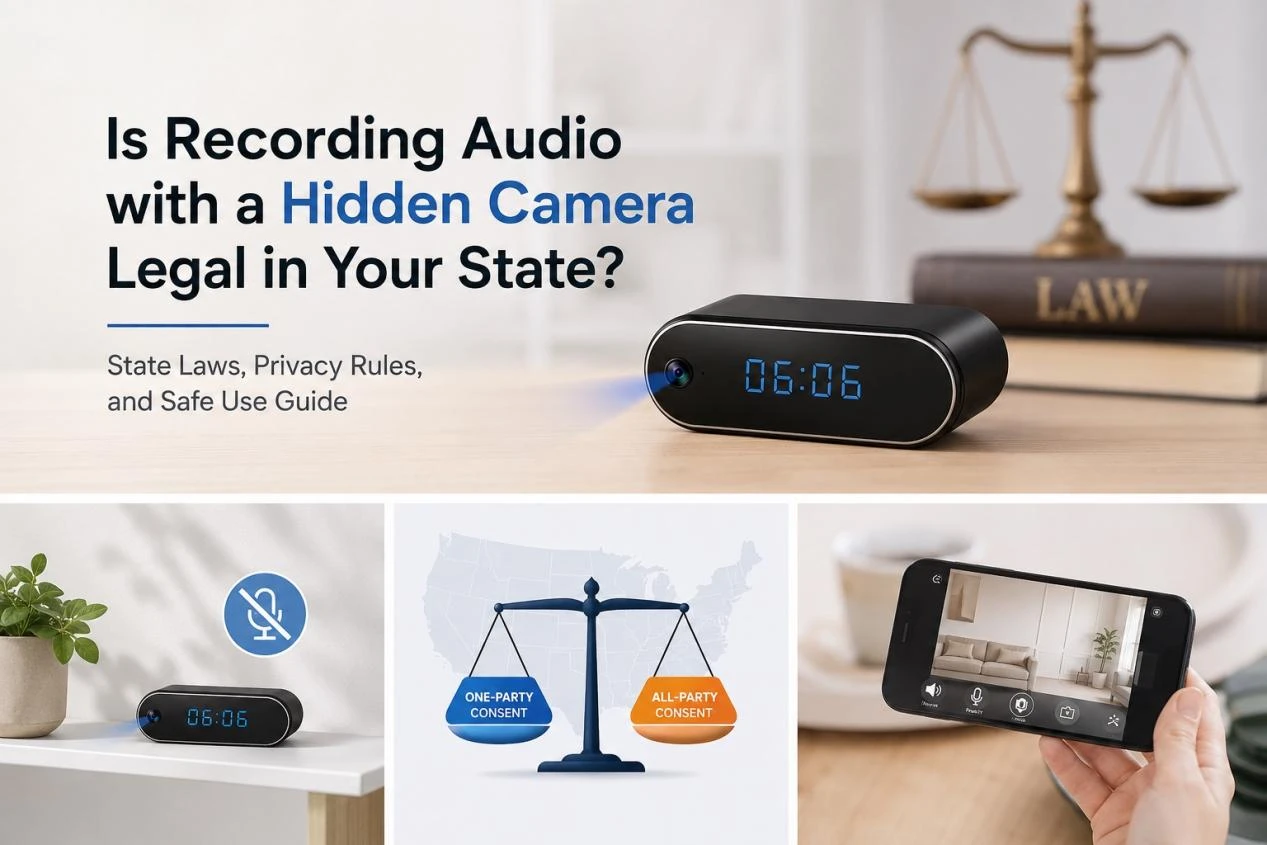
The Short Answer: When Is Hidden Camera Audio Recording Legal?
Hidden camera audio recording is generally lawful only when the recording complies with the consent law that applies where the conversation takes place.
Four questions usually determine the risk:
- Which state's law applies?
- Does that state use one-party or all-party consent?
- Is the camera user a participant in the recorded conversation?
- Is the conversation private or reasonably expected to remain private?
A one-party consent law generally allows a conversation to be recorded when at least one participant agrees. In many cases, the person making the recording can provide that consent if they are personally involved in the conversation.
An all-party consent law, sometimes called a two-party consent law, generally requires every participant in a protected conversation to agree to the recording. The term "two-party" can be misleading. If four people are involved, consent may be required from all four.
The most important limitation is often overlooked:
Owning the hidden camera does not automatically make the owner a consenting party.
Suppose a homeowner speaks with a visitor while a camera records their conversation. In a one-party consent state, the homeowner's participation may satisfy the consent requirement.
Now suppose the homeowner leaves the room and the camera records two visitors talking privately. The homeowner is no longer a participant. The fact that the camera belongs to the homeowner may not provide lawful consent.
Automatic recording does not change this analysis. A microphone that activates with motion detection, records continuously, or saves audio to the cloud can still violate recording laws. Responsibility normally remains with the person who installed, configured, or used the system.
Hidden camera audio is safest when the recorder is a participant, the required consent has been obtained, and the device is not placed in an area with a strong expectation of privacy.
Why Audio and Video Recording Are Treated Differently
Video surveillance and audio surveillance are not the same legal activity.
Video recording laws usually focus on the location of the camera, what it captures, and whether the subject has a reasonable expectation of privacy. This term refers to a situation in which an ordinary person would reasonably expect not to be observed or recorded.
Entrances, porches, driveways, living rooms, kitchens, retail floors, and other shared areas often carry a lower expectation of privacy. Bathrooms, changing rooms, guest bedrooms, locker rooms, showers, and hotel rooms carry a much higher one.
Audio laws focus on something different: the interception or recording of conversations.
A camera may be positioned legally at a front door to record visitors entering the property. Its microphone, however, may capture a private conversation between two people standing nearby. The video and audio portions of the same recording can therefore have different legal status.
The following functions should also be treated separately:
|
Camera function |
Main legal concern |
|
Silent video recording |
Camera location, viewing angle, privacy expectations |
|
Live listening |
Interception of a private conversation |
|
Two-way talk |
Participation in a live communication |
|
Recorded audio |
Consent, interception, storage and later use |
|
Cloud audio storage |
Consent, account access, retention and disclosure |
|
Downloading or sharing audio |
Use or disclosure of recorded communications |
|
AI transcription |
Processing and storing the content of conversations |
A video doorbell with live two-way talk is not automatically equivalent to an unattended hidden camera that records conversations all day. Live communication may involve an active participant, while unattended recording often captures conversations involving no consenting participant connected to the device.
Saved audio also creates risks beyond the original recording. Downloading, forwarding, publishing, transcribing, or using the file in a dispute may trigger additional privacy, employment, contractual, or evidentiary issues.
Turning off the microphone does not solve every surveillance problem. It does, however, remove one of the most legally sensitive features from the system.
Federal Law vs. State Law: Which Rule Should You Follow?
The main federal framework for intercepted communications comes from the Federal Wiretap Act, as amended by the Electronic Communications Privacy Act.
At the federal level, recording is generally permitted when one participant in the conversation consents. This is the federal one-party consent baseline.
That baseline does not allow an unrelated third party to secretly record other people's private conversations. The consenting person generally needs to be a participant or someone whose authorization legally supports the recording.
State law can impose stricter requirements.
If federal law would allow one-party consent but the applicable state requires all parties to consent, the stricter state rule is the one that matters in practice. Users should not rely on federal law alone when configuring a hidden camera with audio.
The recording location is usually important, but it may not be the only factor. Cross-state situations can become complicated when:
- the camera is located in one state;
- the person monitoring it is in another;
- conversation participants live or work in different states;
- audio is transmitted through a cloud service;
- a business operates the same system across multiple locations.
- In these situations, more than one state may claim an interest in the dispute. A company that deploys audio-enabled surveillance across several states should not assume that one internal policy will satisfy every jurisdiction unless that policy is designed around the strictest applicable rules.
Purpose also matters, but not in the way many users expect.
Installing a camera to protect children, monitor a caregiver, prevent theft, or document a security incident may be a legitimate objective. That objective does not legalize a recording that otherwise violates consent or privacy laws.
A criminal or malicious purpose creates even greater risk. Recording for blackmail, harassment, extortion, voyeurism, retaliation, or manipulation can lead to additional civil or criminal liability.
Federal law provides a starting point. State law, the type of conversation, the identity of the recorder, and the surrounding facts determine the real answer.
One-Party vs. All-Party Consent Laws by State
State audio recording laws are often divided into one-party and all-party consent categories. This is useful, but it is not a complete legal test.
Some states distinguish between telephone calls and in-person conversations. Others protect only communications considered confidential or private. Court decisions may also interpret statutory language differently from a simple state chart.
One-Party Consent States
In a one-party consent state, one participant in the conversation can generally authorize the recording.
Commonly cited examples include:
- Colorado
- New York
- Texas
- Tennessee
- North Carolina
- Ohio
- Georgia
This does not mean anyone may secretly record any conversation in those states.
Consider these two examples:
Example 1: A homeowner speaks with a contractor in the kitchen while a camera records the conversation. The homeowner is a participant. One-party consent may be available, subject to other privacy and purpose-based restrictions.
Example 2: The homeowner leaves. The camera continues recording while the contractor speaks privately with an assistant. The homeowner is not a participant in that conversation. One-party consent may no longer protect the recording.
This distinction is especially important for nanny cameras, caregiver cameras, office surveillance, and unattended security systems.
All-Party Consent States
In an all-party consent state, every participant in a protected conversation generally must agree to the recording.
States commonly treated as stricter jurisdictions include:
- California
- Florida
- Maryland
- Massachusetts
- New Hampshire
- Pennsylvania
- Washington
A hidden camera with a microphone presents a greater risk in these states because people may not know that audio is being captured. A visible camera does not necessarily provide adequate notice that conversations are also being recorded.
The safest approach is to obtain clear consent before enabling audio. Depending on the situation, this may involve:
- a written agreement;
- a verbal acknowledgment;
- an employee surveillance policy;
- a clearly presented notice;
- a device prompt or recorded announcement.
A sign alone is not guaranteed to establish valid consent in every state or setting. The wording, visibility, location, and behavior of the participants may all matter.
States with Mixed or Complex Rules
Some states do not fit neatly into a simple chart. Michigan, Oregon, Nevada, Illinois, Connecticut, and Montana are frequently discussed as jurisdictions requiring closer review because their statutes, exceptions, or court interpretations may depend on the type of communication and the recorder's role.
Oregon, for example, has historically treated some in-person conversations differently from electronic communications. Michigan has generated disagreement over how its eavesdropping statute applies when a participant records their own conversation. Illinois has revised its law and focuses heavily on whether a conversation is private.
For these states, a one-word label is not enough.
|
General category |
Basic rule |
Hidden camera warning |
|
One-party consent |
One participant may consent |
The camera owner still needs to be a participant or have valid authorization |
|
All-party consent |
All participants generally consent |
Unattended recording creates high risk |
|
Mixed or fact-specific |
Rule depends on communication type and circumstances |
Review current statutes and court decisions |
A state list should be treated as a screening tool, not final legal advice. Laws and judicial interpretations can change.

Common Hidden Camera Audio Scenarios
The legality of hidden camera audio becomes clearer when applied to actual use cases.
Hidden Cameras at Home, Nanny Cams and Caregiver Monitoring
Homeowners generally have broad authority to install security cameras in their own homes, especially in entrances and shared areas. That authority is not unlimited.
A nanny cam may legally record silent video in a common room, yet its microphone may violate state law by recording the nanny's conversations. This becomes more likely when the parent is not present and is therefore not a participant.
The same concern applies to:
- elder-care monitoring;
- housekeepers;
- babysitters;
- maintenance workers;
- visitors;
- roommates;
- adult family members.
A child's bedroom may be monitored for safety, particularly when the child is an infant or dependent. Recording adults in bedrooms, guest rooms, bathrooms, or changing areas is far more dangerous and may violate separate privacy or voyeurism laws even when audio is disabled.
A legitimate caregiving purpose does not remove the need to comply with recording laws. Users should tell caregivers about monitoring, obtain any required consent, and disable audio when it is not necessary.
Employees, Offices, Retail Stores and Warehouses
Businesses commonly use video surveillance to deter theft, investigate incidents, and protect employees and customers. Audio recording is more sensitive.
A camera installed above a cash register may be reasonable for video security. Recording every conversation between employees and customers may create a different legal issue.
Higher-risk workplace areas include:
- employee break rooms;
- private offices;
- meeting rooms;
- locker rooms;
- changing areas;
- restrooms;
- areas used for confidential HR or medical discussions.
Employers should define what is recorded, why it is recorded, who can access it, and how long files are retained. Employee handbooks and written consent forms can support compliance, but they must match the law of each location.
Customer notice also requires care. A posted sign may help establish awareness, but it is not a universal substitute for consent.
Businesses operating in several states should either apply the strictest audio rule across all locations or disable audio by default unless a location-specific legal review approves it.
Outdoor Cameras, Doorbells, Renters and Short-Term Rentals
Outdoor cameras usually face entrances, driveways, sidewalks, streets, parking areas, or a property owner's yard. These areas generally carry a lower expectation of visual privacy.
Audio remains a separate issue.
A doorbell camera may capture a visitor speaking directly to the homeowner through two-way audio. It may also record neighbors or delivery workers having an unrelated private conversation nearby. The second situation creates more risk because the device owner may not be a participant.
Camera angles also matter. Outdoor surveillance should not be deliberately aimed through a neighbor's bedroom window or into another home. Capturing a small part of a neighboring property incidentally is different from intentionally monitoring a private space.
Renters should review their lease, building rules, and roommate arrangements before installing a camera. Property rights, shared spaces, and consent can overlap.
Short-term rental platforms may impose rules stricter than state law. A platform can prohibit indoor cameras even where local law might otherwise permit disclosed surveillance. Users must comply with the law and the platform agreement.
Where Hidden Camera Recording Is Most Likely to Be Illegal
Certain locations create an immediate privacy concern.
Hidden cameras should not be installed in places where people undress, sleep, bathe, receive private care, or reasonably expect seclusion. These commonly include:
- bathrooms;
- showers;
- dressing rooms;
- changing rooms;
- locker rooms;
- hotel rooms;
- guest bedrooms;
- medical examination areas.
The fact that a room is located inside the camera owner's property does not remove another person's expectation of privacy.
Recording is also especially risky when the camera owner is not part of the conversation. An unattended microphone that captures private discussions between employees, caregivers, guests, tenants, or family members may amount to third-party interception.
The following conduct creates further exposure:
- aiming cameras into a neighbor's home;
- using hidden recordings for sexual purposes;
- recording to threaten, embarrass, or blackmail someone;
- inducing a person to make damaging statements;
- publishing private audio online;
- sharing recordings beyond a legitimate security need;
- keeping audio indefinitely without a defined purpose.
Intent can make a bad situation worse. A valid security purpose may explain why a camera was installed, but it does not override recording consent laws.
When a location is highly private or the recorder is not a participant, the correct decision is usually to disable audio and reconsider whether the camera should be there at all.
What Can Happen If You Record Audio Illegally?
Illegal audio recording can create criminal, civil, evidentiary, employment, and commercial consequences.
Depending on the applicable law and the facts, consequences may include:
- criminal charges;
- fines;
- imprisonment;
- civil lawsuits;
- statutory damages;
- compensation for actual losses;
- attorney fees;
- court orders restricting further use;
- termination or disciplinary action;
- damage to a company's reputation.
A common mistake is assuming that a recording becomes lawful or admissible because it captured wrongdoing.
It does not.
Audio showing theft, abuse, threats, or misconduct may still face challenges if it was obtained illegally. A court may consider the recording method, authenticity, relevance, completeness, chain of custody, and state evidence rules.
The person who made the recording may also face a countersuit. This can turn a potentially useful security record into a separate legal problem.
Users should therefore treat audio as a controlled surveillance feature, not as a harmless extension of video recording.

How to Use a Hidden Camera with Audio More Safely
The safest setup is the one that collects only the information genuinely needed for security.
Use the following process before enabling audio:
Check the law where the recording occurs.
Do not rely only on the state where the device was purchased, where the company is registered, or where the cloud server is located.
Identify the conversation participants.
Determine whether the camera user is actually part of the conversation. Device ownership alone is not enough.
Obtain clear consent when required.
Use written agreements, verbal acknowledgments, employee policies, or other appropriate notices. Do not assume a small sign automatically satisfies every state's standard.
Disable the microphone when audio is unnecessary.
Review the device settings, mobile application, recording schedule, cloud plan, and motion-triggered recording options.
Keep cameras out of high-privacy areas.
Bathrooms, changing areas, guest bedrooms, locker rooms, and similar spaces should generally be excluded.
Limit access to recordings.
Only authorized users should be able to view, download, export, or share files.
Set a defined retention period.
Keeping recordings indefinitely increases privacy and data-security risk.
Review contracts and policies.
Leases, employment agreements, platform rules, customer contracts, and industry regulations may impose additional restrictions.
Get legal advice for high-risk use.
This is particularly important for employee monitoring, cross-state operations, caregiver investigations, litigation, and covert evidence collection.
Product design can also reduce misuse. A compliance-focused hidden camera should provide:
- independent audio controls;
- separate audio and video settings;
- a clear microphone status;
- role-based user permissions;
- configurable recording schedules;
- local and cloud storage options;
- adjustable retention settings;
- accurate operating instructions.
These controls do not make every recording legal. They give users the ability to configure the system in line with the rules that apply.

Check the Law Before Turning On the Microphone
Recording audio with a hidden camera is legal only when the applicable consent, privacy, and surveillance rules are satisfied. Federal law generally provides a one-party consent baseline, but stricter state laws may require every participant to agree. A camera owner who is not part of the conversation cannot assume that equipment ownership provides consent.
When the law, location, or participant status is unclear, leave the microphone off.
Allcam develops configurable hidden surveillance solutions with independent audio controls, flexible storage options, and access-management features for residential and commercial applications. Contact Allcam to discuss a camera configuration that fits your security requirements and compliance strategy.
This article provides general information and is not legal advice. Recording and surveillance laws change, and their application depends on the specific facts. Consult a qualified attorney in the relevant jurisdiction before using covert audio recording.
FAQ
Can I record conversations in my own home without telling anyone?
Not automatically. Owning the home does not remove the privacy or recording rights of visitors, employees, tenants, caregivers, or family members. The answer depends on state consent law, whether you participate in the conversation, and whether the conversation is private.
Is nanny cam audio legal?
It may be, but audio requires separate analysis from video. In an all-party consent state, recording a nanny's conversations without consent can be unlawful. Even in a one-party consent state, a parent who is not present may not qualify as a consenting participant.
Does a "Recording in Progress" sign make audio recording legal?
A sign can provide notice, but it does not guarantee valid consent in every jurisdiction. Some situations require clearer acknowledgment or written agreement. The sign must also be visible and specific enough to communicate that audio, not only video, is being recorded.
Is live two-way audio treated the same as saved audio?
Not always. Live two-way talk usually involves active communication with the camera user. Saved audio can capture unattended conversations and creates additional risks involving storage, access, downloading, disclosure, and use.
Can illegally recorded audio be used in court?
Possibly, but it may be excluded or restricted. Admissibility depends on the lawfulness of the recording, the purpose for which it is offered, authenticity, relevance, and state evidence rules. The recorder may still face separate liability.
Should I disable audio on my security camera?
Disable it when audio is not necessary or when consent is uncertain. Silent video is not automatically legal in every location, but removing audio often reduces the most serious wiretapping and conversation-privacy risks.
