


Security cameras have become an essential part of home and business protection. Many models rely on local MicroSD card storage for recording video, offering privacy, no monthly fees, and instant access to footage. A question we frequently receive from users and partners is: how long will an SD card for a security camera last before it fails or needs replacement?
The lifespan of an SD card in a security camera is not fixed. It depends on several key factors, including the card type, recording mode, video resolution, and environmental conditions. In typical real-world use, standard consumer-grade cards often last 6–12 months under continuous recording, while high-endurance cards designed for surveillance can reliably serve 2–5 years or longer.
This guide explains the real durability of SD cards in security cameras, the factors that determine how long they last, realistic recording durations by capacity, the mechanics of loop recording, and practical recommendations for choosing the right card.

What Is an SD Card and Its Role in Security Cameras
An SD card (most commonly microSD in modern cameras) is a flash-based, non-volatile storage device that retains data without power. In security camera systems, the card serves as the primary or backup recording medium.
Unlike cloud-only solutions, local SD card storage keeps all footage on the device itself. This approach eliminates recurring subscription costs, reduces dependency on internet connectivity, and gives users full control over their video data - a priority for privacy-conscious customers.
Security cameras use SD cards in two main ways:
- Continuous recording (24/7)
- Event-triggered recording (motion detection, sound detection, scheduled)
Because surveillance involves very frequent write operations - especially in continuous mode - the card experiences far heavier wear than in phones, tablets, or casual photo use. This is why choosing the correct card type is critical.
SD cards provide affordable, private, always-available local storage, but their longevity in security cameras is directly tied to how intensively they are written to.
Key Factors Affecting SD Card Lifespan and Recording Duration
The lifespan of an SD card for security camera use is governed by a small number of core factors. Understanding these helps predict real-world performance and avoid premature failures.
- Write/Erase Cycles - Every flash memory cell can only withstand a limited number of program/erase (P/E) cycles before it becomes unreliable. Standard consumer cards typically handle 1,000–3,000 cycles per cell. High-endurance surveillance cards are engineered for 10,000–60,000+ cycles, making them far more suitable for loop recording.
- Recording Resolution and Bitrate - Higher resolutions (4K, 2K) and higher bitrates generate much more data per second, increasing write frequency and accelerating wear compared to 1080p or 720p.
- Recording Mode - Continuous 24/7 recording consumes the card fastest. Motion-activated or event-triggered recording can extend lifespan by 3–10× depending on activity level in the monitored area.
- Environmental Conditions - Extreme heat (above 70°C), cold, high humidity, or frequent power cycling can degrade NAND flash cells more quickly. Outdoor or unventilated installations are especially vulnerable.
- Card Quality and Brand - Reputable manufacturers (SanDisk, Samsung, Kingston) produce high-endurance lines specifically rated for continuous-write applications. Generic or low-cost cards often fail much sooner.
Continuous high-resolution recording on a standard card usually leads to failure within months. Switching to a high-endurance card and motion-based recording dramatically extends reliable service life.

How Long Different Capacities Can Record Footage
While lifespan refers to how long the card remains functional, many users also want to know how many days of video a given capacity can hold before overwriting begins.
The table below shows approximate recording durations under typical conditions (H.264/H.265 compression, average bitrate). Actual times vary depending on scene complexity, frame rate, and compression efficiency.
|
Capacity |
Motion/Event-Triggered (1080p) |
Continuous Recording (1080p) |
Continuous Recording (4K estimate) |
Typical Use Case |
|
32GB |
2–3 days |
≈20 hours |
≈5–10 hours |
Short-term or very low activity |
|
64GB |
4–6 days |
≈40 hours |
≈10–20 hours |
Moderate home use |
|
128GB |
8–12 days |
≈80 hours |
≈20–40 hours |
Recommended balance for most users |
|
256GB |
16–24 days |
≈160 hours |
≈40–80 hours |
Longer retention or higher activity |
Larger capacities not only store more days of footage but also reduce the frequency of overwrite cycles, indirectly extending the card's physical lifespan. For most security camera installations, 128GB or 256GB high-endurance cards offer the best combination of retention time and durability.
Understanding Loop Recording (Overwrite Mechanism)
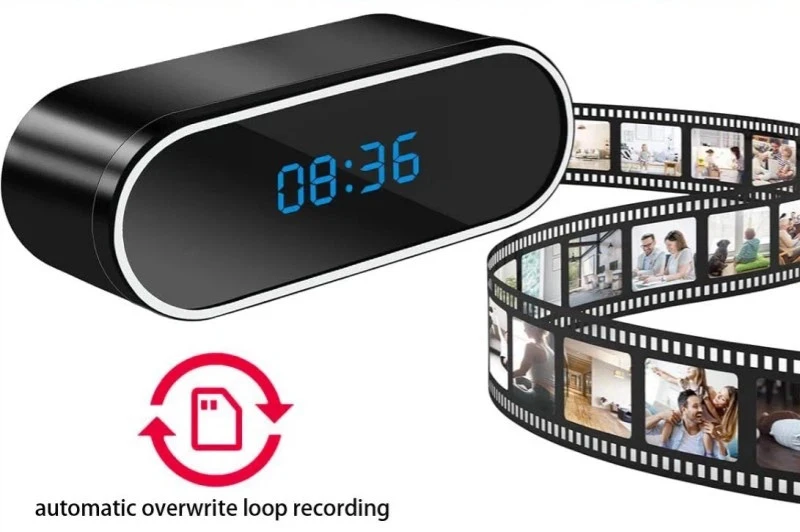
Loop recording - also called overwrite or circular recording - is the default behavior in nearly all SD card-based security cameras.
When the card reaches full capacity, the camera automatically deletes the oldest files to make room for new recordings. This ensures the system never stops capturing video due to lack of space.
Advantages:
- Continuous protection without manual intervention
- Always retains the most recent footage
Disadvantages:
- Older recordings are permanently overwritten unless manually exported
- Every overwrite counts as additional write/erase cycles, accelerating wear
Because loop recording creates constant write activity, it is one of the most demanding workloads for flash storage. Standard consumer cards often fail within months under this condition, while high-endurance models are specifically designed to handle it reliably for years.
In practice: Loop recording is ideal for 24/7 monitoring, but pairing it with a high-endurance card is essential to avoid frequent replacements.
How to Choose the Right SD Card for Your Security Camera
Selecting an appropriate SD card is the single most effective way to maximize reliability and minimize maintenance.
- We strongly recommend high-endurance or surveillance-grade cards over standard consumer models. These cards use higher-grade NAND flash, advanced wear-leveling algorithms, and error-correction techniques optimized for continuous recording.
- Recommended high-endurance models (widely compatible and proven in real installations):
- Samsung PRO Endurance series - excellent write endurance, long warranty periods, strong performance in continuous-write scenarios
- SanDisk High Endurance / Max Endurance series - balanced price-performance, very reliable in surveillance applications
- Kingston High Endurance - good tolerance for temperature extremes, solid choice for outdoor cameras
Selection checklist:
- Capacity - Choose 128GB or higher for practical retention periods and reduced overwrite frequency.
- Speed rating - Minimum Class 10, preferably U3 / V30 to support HD and 4K recording without dropped frames.
- Endurance rating - Look for cards that explicitly state "high endurance," "surveillance," or list high total bytes written (TBW) or recording hours.
- Compatibility - Always verify the card is listed as supported by your camera manufacturer to avoid format or recognition issues.
- Avoid - Standard "Evo," "Ultra," or generic no-name cards - they are not built for surveillance workloads.
Replace the card when you notice frequent recording errors, corrupted files, slow performance, or camera warnings about storage health.
Summary: Investing in a genuine high-endurance SD card is far more cost-effective than repeatedly replacing failed standard cards.
Conclusion
The question "how long will an SD card for security camera last" has no single answer - but the pattern is clear. Standard consumer cards struggle to survive more than 6–12 months of continuous use, while high-endurance surveillance cards routinely deliver 2–5 years or more of reliable service.
By choosing a high-endurance model, preferring motion/event-triggered recording when possible, using adequate capacity (128GB+), and protecting the camera from extreme temperatures, most users can achieve stable, low-maintenance local recording for years.
If you are designing, reselling, or installing security systems and need dependable local-storage solutions - including micro cameras, hidden cameras, or custom configurations - feel free to reach out. We are happy to discuss the right storage and hardware approach for your project.
Looking for Hidden Camera Manufacturers?
If you are searching for a reliable hidden camera manufacturer, Shenzhen Allcam Technology Co., Ltd. has been specializing in this field since 2014. Our product range includes micro cameras, camouflage cameras, wireless Wi-Fi cameras, body-worn hidden cameras, nanny cameras, DIY module cameras, motion-detection hidden cameras, and more.
All our hidden camera solutions support local MicroSD / TF card storage (up to 128GB), loop recording, event-triggered recording, or pure local-only mode - no mandatory cloud subscription required. Data stays on the device, maximizing privacy and minimizing operating costs.
If you are looking for a trusted manufacturing partner for covert or miniature security cameras, contact us to discuss your project. We look forward to supporting your next solution.
