


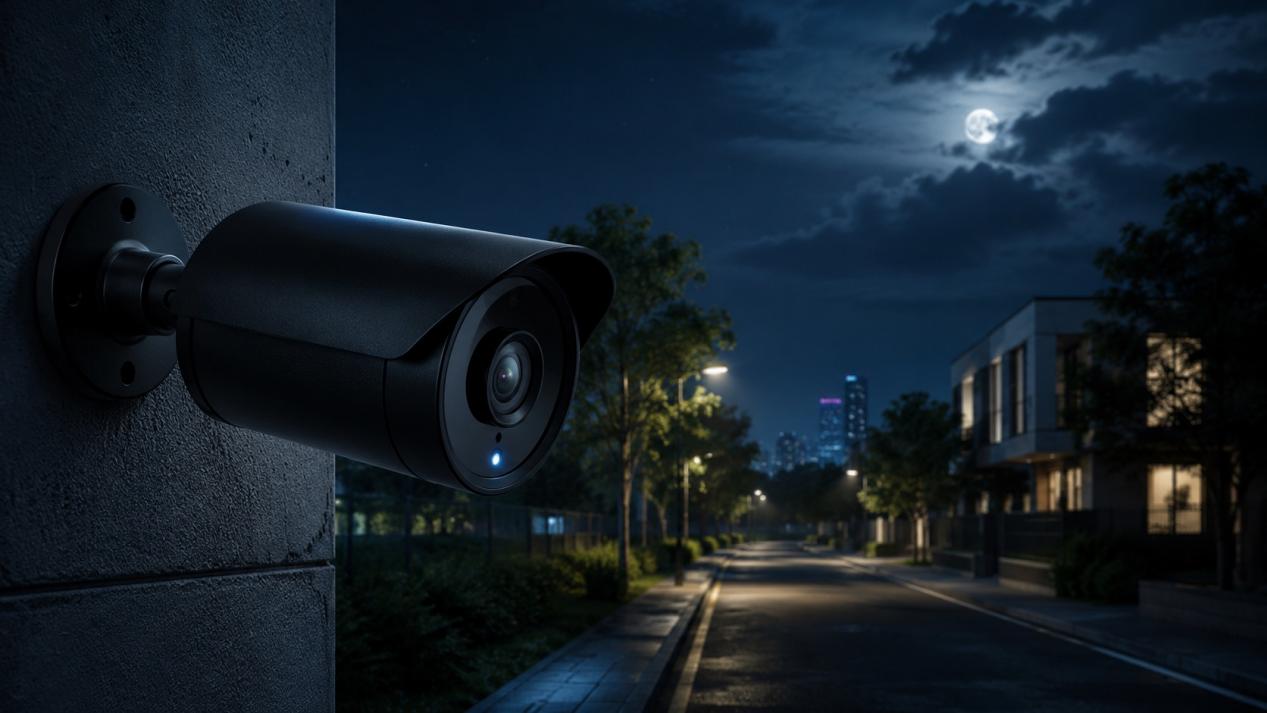
Starlight sensor technology helps a camera produce usable video when only a small amount of ambient light is available. It does not rely on one "magic" sensor. The result comes from the image sensor, lens, exposure control, and image-processing system working together. A well-designed starlight camera can keep more color and detail than a conventional camera in dim rooms, streets, parking areas, and other low-light locations. It still has limits, especially when the scene becomes completely dark or the subject moves quickly.
What Is Starlight Sensor Technology?
Starlight sensor technology is a low-light imaging approach used in security cameras. It combines a light-sensitive CMOS image sensor, suitable optics, exposure control, and image-processing algorithms to produce useful video from very limited ambient light.
"Starlight" is widely used in the surveillance industry, but it is not a universal technical standard. There is no single sensor specification, lux threshold, or certification that every starlight camera must meet. Two products can carry the same label and deliver very different results.
Starlight should also not be confused with Sony STARVIS. STARVIS is Sony's trademark for an image-sensor family designed for high sensitivity in security and industrial imaging. Many starlight cameras use STARVIS sensors, while others use sensors from different manufacturers. Even with the same sensor, the final image depends on the lens, firmware, processor, and enclosure.
The sensor is the foundation. It is not the complete system.
How Does Starlight Camera Technology Work?
Light passes through the lens, reaches the image sensor, and becomes an electrical signal. A starlight camera improves this process at several points so that a weak signal remains usable.
The Image Sensor Collects Weak Light
The sensor contains millions of light-sensitive pixels. Each pixel converts incoming photons into electrical charge. In a dark scene, few photons reach the sensor, so the useful signal can be buried in electronic noise.
Important low-light factors include sensor size, pixel size, quantum efficiency, and read noise. Larger pixels generally collect more photons when other conditions are similar. A 2.9 μm pixel, for example, has about 2.1 times the surface area of a 2.0 μm pixel. That does not make the final image 2.1 times better, but it can create a stronger starting signal.
Back-side illuminated CMOS, or BSI CMOS, reduces obstruction between incoming light and the photosensitive area. Stacked sensors separate much of the processing circuitry from the light-sensitive layer. Both designs can support better performance, but neither guarantees strong night video on its own.
The Lens Determines How Much Light Reaches the Sensor
A lower F-number usually means a larger aperture and more light reaching the sensor. Under comparable conditions, an F0.95 lens can theoretically pass about 2.8 times as much light as an F1.6 lens.
Very large apertures also reduce depth of field, make focus more sensitive, and may increase lens size and cost. Actual transmission depends on the glass, coatings, focal length, and mechanical design.
This matters even more in hidden cameras. A pinhole lens fits behind a small opening, but that opening can restrict light. A strong sensor cannot fully compensate for a poorly matched lens.
Exposure and Gain Make the Image Brighter
When a scene becomes darker, the camera can slow its electronic shutter. The longer exposure collects more light and can make a static room look much brighter.
It can also cause serious motion blur.
A walking person may lose facial detail. Hands, clothing edges, and vehicle plates can smear. A bright empty-room image is therefore a weak test of surveillance performance.
The camera can also increase analog or digital gain. Gain brightens the signal but amplifies noise. Some cameras can adjust a motorized iris. Many compact and hidden cameras use a fixed aperture, leaving shutter speed, gain, and processing to handle changing light.
The ISP Controls Noise, Color, and Detail
The image signal processor, or ISP, controls exposure, white balance, color, sharpening, noise reduction, and day-to-night switching.
Two-dimensional noise reduction works within one frame. Three-dimensional noise reduction compares multiple frames. Temporal processing can clean up a still scene but may create ghosting around moving subjects.
Strong denoising can erase skin texture, small text, and fabric patterns. Excessive sharpening creates halos and false edges. The best starlight camera preserves useful detail without depending on extreme exposure, gain, or smoothing.
Why Can Starlight Cameras Stay in Color Longer?
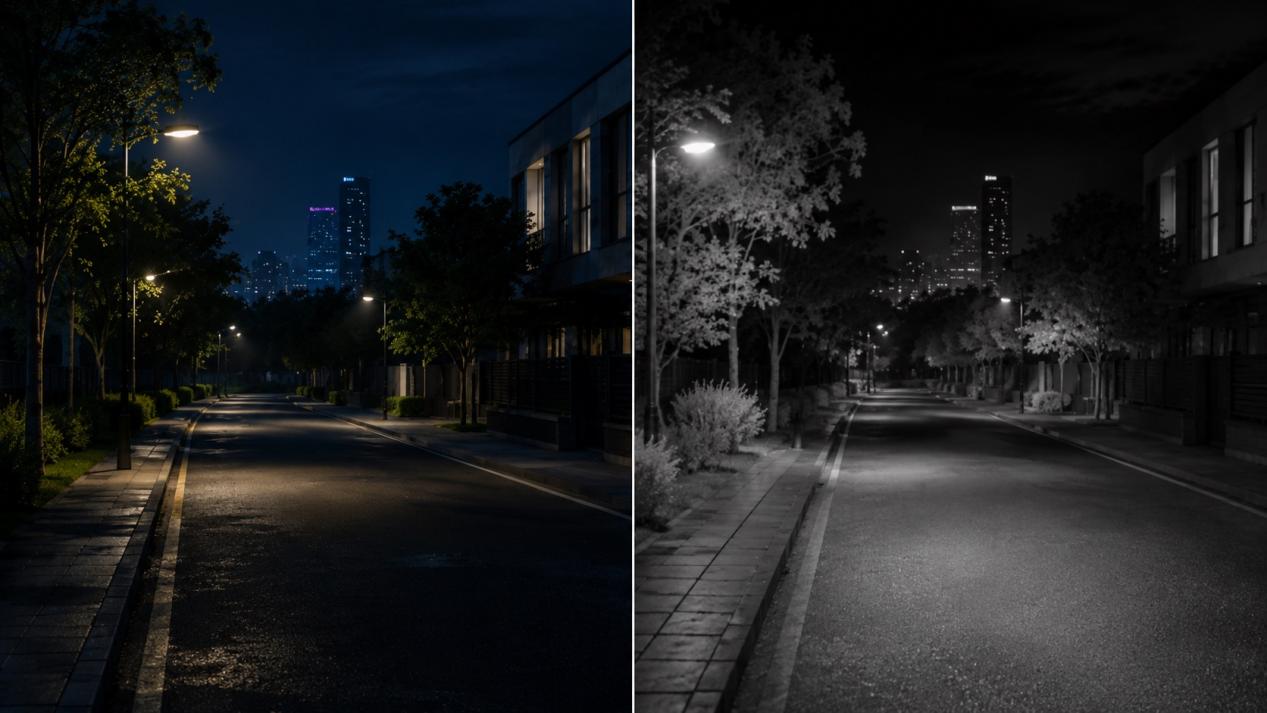
Color video requires more usable light than black-and-white video. As illumination falls, color channels become noisy and unstable. A conventional camera may switch to monochrome early because removing color information produces a cleaner image.
A starlight camera delays that switch. Its sensor creates a stronger signal from weak light, while the lens, exposure controls, and ISP work to maintain color information. This allows the camera to stay in color after a standard camera has already changed to black and white.
Color can help identify:
- A jacket, bag, or vehicle
- A product or package
- Signal lights or equipment status
- Changes within a room or work area
"Color night vision" does not mean perfect color reproduction. As light decreases, saturation falls, white balance becomes less stable, and color noise rises. A well-tuned camera should switch to monochrome when color no longer adds reliable information.
Keeping color at any cost is not better engineering.

Starlight vs. Infrared Night Vision: What Is the Difference?
Starlight imaging mainly uses visible ambient light. Infrared night vision creates illumination with IR LEDs.
|
Comparison |
Starlight imaging |
Infrared night vision |
|
Main light source |
Moonlight, streetlights, room lighting, or other visible ambient light |
Built-in or external IR LEDs |
|
Night image |
Can remain in color when enough ambient light exists |
Usually black and white in night mode |
|
Complete darkness |
Cannot rely on ambient visible light alone |
Can operate with active IR illumination |
|
Effective range |
Changes with available light and its direction |
Depends on IR power, beam angle, lens, and surface reflectivity |
|
Common problems |
Noise, color shift, motion blur |
IR reflection, white haze, overexposure |
|
Illumination visibility |
No active light is needed in suitable scenes |
850 nm LEDs may show a faint red glow; 940 nm is more discreet but usually less efficient |
These technologies are not mutually exclusive. Many cameras stay in color while ambient light remains useful, switch to monochrome as it falls, and activate IR in complete darkness.
For a site with steady street lighting, starlight performance may preserve more useful color. For a sealed room with no light, infrared is the reliable choice. A combined system covers more conditions than either technology alone.
How to Read Starlight Camera Specifications
A low lux number can look impressive, but it does not tell the whole story. Minimum illumination is useful only when the test conditions are disclosed.
Minimum Illumination and Lux
Lux measures illumination. A camera's minimum-illumination rating is meant to show how little light it needs to produce a usable image.
The problem is that "usable" has no single definition. Manufacturers may test at different shutter speeds, gain levels, lens apertures, frame rates, and image thresholds. Color and black-and-white values must also be separated.
There is no official rule that a starlight camera must operate below 0.001 lux. That figure appears in many product descriptions, but it is not a universal certification threshold.
Shutter Speed, Frame Rate, and Motion Blur
A camera may support 30 fps, yet its lowest lux figure may be measured with an exposure longer than 1/30 second. The video output can still be labeled 30 fps even when new image information is captured less often.
For surveillance, footage of moving people is more valuable than a bright screenshot of an empty room. Check whether faces, hands, and clothing edges remain clear at the intended distance.
Lens Aperture, Gain, and Test Conditions
When comparing low-light cameras, check:
- Color and monochrome minimum illumination
- Lens F-number
- Shutter speed and gain used for the rating
- Whether slow shutter, IR, or white light was active
- Actual frame rate in low light
- Whether the value covers a bare sensor, camera module, or finished camera
The last point matters in hidden cameras. A good module can lose substantial light behind a small opening, tinted panel, decorative cover, or glass surface.
WDR Is Not the Same as Low-Light Sensitivity
Wide dynamic range, or WDR, handles bright and dark areas within the same frame. Low-light sensitivity handles a scene that is dark overall.
Claims such as 120 dB or 140 dB often refer to multi-exposure or system-level WDR. They should not be treated as direct measurements of low-light sensitivity.
Benefits and Limitations of Starlight Cameras
The main benefit is simple: a starlight camera produces more useful video from limited ambient light.
It can keep color longer, reduce dependence on visible white light, and preserve details that a standard camera may lose. This is useful in parking areas, shops, offices, warehouses, hallways, bars, clubs, and outdoor locations with steady background lighting.
The limits are equally clear. A starlight camera cannot create real scene information when no light reaches the sensor. Slow shutter creates blur. High gain creates noise. Aggressive 3D noise reduction removes fine detail. Fog, rain, dust, glare, and dirty covers reduce contrast further.
Higher-performance sensors and processors may also increase cost, power consumption, heat, and storage demand. Poor low-light tuning can raise bitrate without adding useful evidence.
A brighter image is not necessarily a more useful surveillance image.
The goal is readable detail under realistic motion.
What Starlight Technology Means for Hidden Cameras
Low-light performance becomes harder when the camera is concealed inside another object. The sensor specification may be strong, but the complete optical path determines the final result.
Pinhole Lenses Limit Light Collection
Pinhole and miniature lenses fit behind small openings, but their effective aperture can restrict light. Two hidden cameras using the same sensor may perform differently because one uses a better lens and cleaner optical path.
A low-light camera module should be tested with its final lens, not only with a larger reference lens on an open bench.
The Housing Changes the Optical Path
A deep mounting hole can block off-axis light. Dark plastic, tinted acrylic, mirrored material, or decorative glass can reduce transmission. Poor alignment between the lens and opening may soften or darken part of the image.
Internal surfaces can also reflect light back into the lens. These effects become more visible at night when gain increases. Finished-product testing is therefore essential.
IR Reflection, Power, and Heat Need Attention
IR can reflect from glass, plastic, mirror coatings, or the inside of an enclosure. This may create white haze, bright rings, or severe overexposure.
Better starlight performance can reduce the need for close-range IR when some ambient light exists. It cannot remove the need for IR in every dark scene.
Compact hidden cameras also have limited space for processors, cooling, and batteries. Strong denoising, AI enhancement, high bitrate, and continuous wireless transmission all consume power and create heat. Balanced settings usually outperform an "everything at maximum" approach.

How to Choose the Right Low-Light Camera
Do not choose a camera only because its name includes "starlight," "super starlight," or "ultra low light."
Compare the complete system:
- Sensor and pixel size
- Lens aperture and actual transmission
- Color and monochrome minimum illumination
- Shutter speed used in low-light testing
- Motion clarity at the required distance
- IR or white-light support
- Finished-enclosure night footage
- Power, heat, bitrate, and storage requirements
Starlight sensor technology is most useful when it preserves color, detail, and motion clarity from the small amount of light genuinely available. It is not a substitute for proper optics, realistic testing, or supplemental lighting in total darkness.
Allcam develops hidden and low-light camera solutions around the complete imaging path, including the sensor, lens, enclosure, IR design, power limits, and final application. Contact Allcam to discuss a custom camera module or concealed surveillance design for your target lighting conditions.
Common Questions About Starlight Sensor Technology
Can a Starlight Camera See in Complete Darkness?
Not with ambient visible light alone. If no usable light reaches the sensor, the camera needs IR, white light, thermal imaging, or another active method. "0 lux full color" products normally use supplemental light, image fusion, or related support.
Is Sony STARVIS the Same as Starlight?
No. STARVIS is Sony's image-sensor brand. Starlight is a broader surveillance term for low-light performance. A starlight camera may use a STARVIS sensor, but the terms are not interchangeable.
Is Starlight Better Than Infrared Night Vision?
Starlight is better when some ambient light exists and color matters. Infrared is more reliable in complete darkness. A camera that combines both is usually more versatile.
Does a Lower Lux Rating Always Mean Better Video?
No. The rating matters only when shutter speed, aperture, gain, frame rate, image mode, and test method are known. Comparable footage of moving subjects is a better purchasing reference.
